
Two of my writing pals (w.p.s) are therapists, and we recently explored the reasons we’re not-writing some of our stories. Primarily because we don’t want to upset people who are still alive. We played with ideas for pseudonyms, or name withheld, as is done for some of the “Readers Write” pieces in The Sun. Then w.p. 1 shared that a former client had published an article wherein my w.p.’s therapeutic advice was quoted — anonymously. At least it was accurate, she said. Sometimes, she continued, clients credit me with advice I know I wouldn’t have given.
Perhaps all of us have had that experience: someone tells a story wherein we play a role, and their version of the story puts words in our mouths or jitterbugging on our dance moves, words and jitterbugging we either have no recollection of, or that we feel very confident we would neither have spoken nor danced.
I’ve experienced this a couple of times: once with a fellow mother who says I told her daughter (5 y.o., dressed up as a princess and wasn’t she *beautiful!*) it’s inner beauty that counts (sounds like me, have no memory of saying it); another time with a colleague who tells me that at the end of a group meeting where we were expressing gratitudes, I stated that I was grateful for birth control (OK, well, maybe I would have said that, but not at that particular meeting!).
So I’ve had enough opportunities to learn that the truism about not knowing how we’re affecting other people is, in fact, true. But the week before Christmas, I forgot this. My sons were sleeping late that week, and playing video games and raiding the fridge and generally having a Fine Time Of It (well, the 17 y.o. had basketball practice most mornings, but still!), and on this particular morning, I was sweating over the details of boxing up cookies for the relatives. And I wasn’t being very calm or polite or zen-y, I was muttering under my breath and then I was squawking in what I know is an unpleasant-to-hear tone. Perhaps my decibels increased.

The 17 y.o. (white jersey) guarding some guy.
At which point the 17 y.o. came in from basketball practice, assessed the situation and took a shower before tackling cello practice. After cello, he and his sweetie headed out for their own Xmas fun, driving to see some spectacular lights in Bedford County. Then they went out for a nice dinner and he texted they’d be home by 11. And he was. But his girlfriend, god bless her, had driven him home because when he went to get in his car, he sort of stumbled and he was dizzy and he felt sick.
Turns out he’d taken a shoulder/knee combo to the head in basketball practice. That he didn’t remember it, only remembered sitting on the floor with people around him. That he took himself out of practice for the rest of the practice. That his coach had called him mid-afternoon to see how he was doing. He’s already had two concussions, so he had a pretty good idea that this was, likely, another one. A third one. The one that his doctor and his parents have said will mean he has to stop playing basketball.
But when I’d grumpily, perfunctorily asked, how was practice, he’d said fine. Because he’d already heard me grumping in the kitchen and who wants to deal with a grumpy mother who’s said if you get another concussion you can’t play contact sports anymore? No one wants to deal with a grumpy mama, grumpy anyone. I don’t. But I was so caught up in my own angst about the packages I foreclosed even the remote possibility that he might have mentioned something about his concussion* when he returned from practice. I have now Officially Learned My Lesson. The temporary relief that grumping provides me is not worth its cost: it closes off communication, interaction, engagement, connection. So now, even when I am grumpy I am trying to behave, if not cheerfully, at least neutrally. (Note: I do not always succeed.) And here’s the connection to writing: even when I don’t feel like writing, I am trying to behave as if I’m a writer, because if I don’t, I close off all those same opportunities: communication, interaction, engagement, connection).
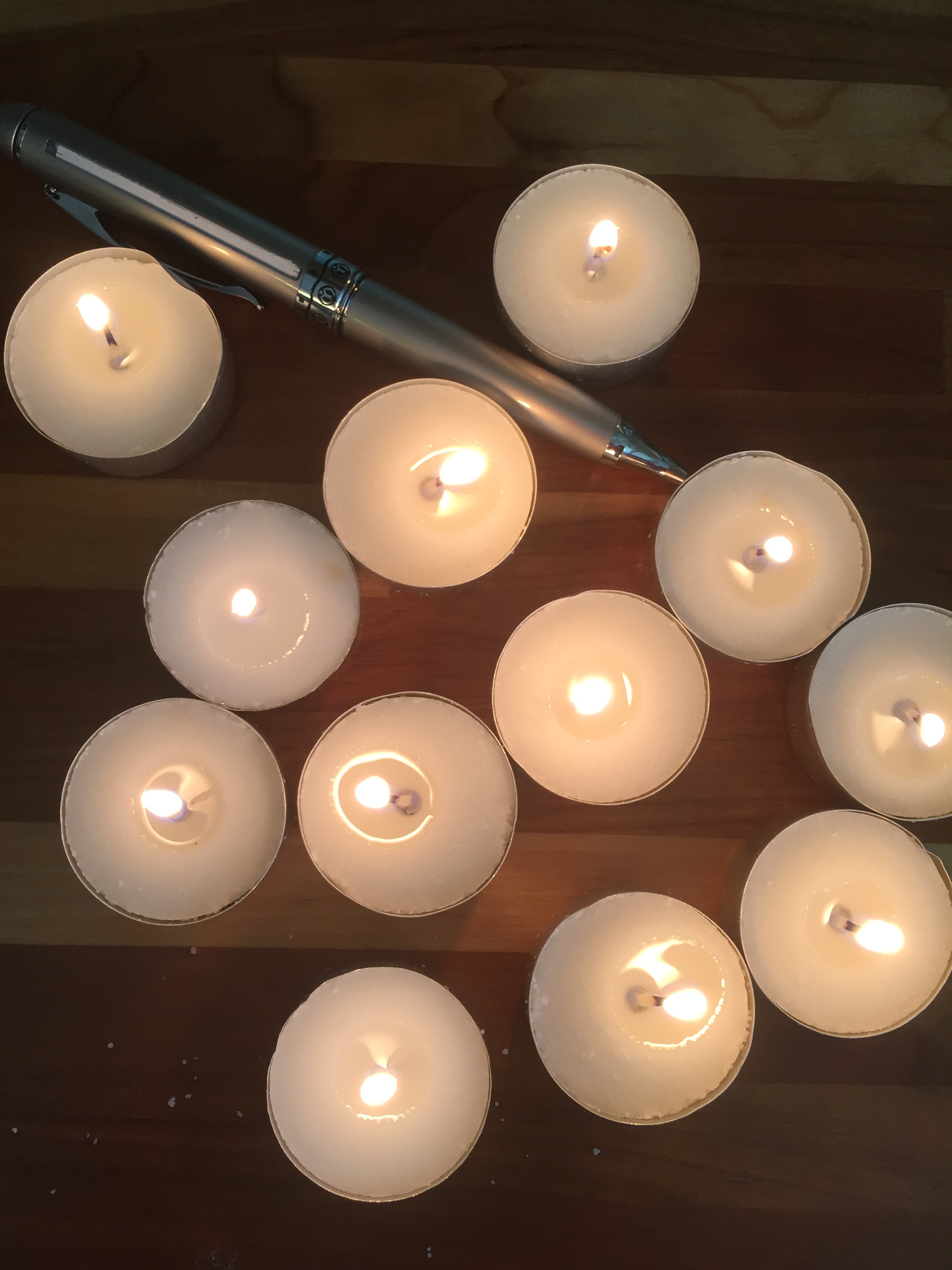
 So I set my timer for fifteen minutes and I uncap my pen, lay out my paper (sometimes I have to light a candle and make tea because some days, when I feel really grumpy, it is HARD to begin writing) and then I hit “start” on the timer and I write. Sometimes I write all the reasons I am not a writer. Sometimes I doodle. Sometimes I draft dialogue or make a list of questions for my piece. Sometimes I bitch and moan about groceries, laundry yadda yadda yadda. And more often than not, I continue after the timer’s ding, finishing the dialogue or thinking about the answers to the questions or looking up a word or, on the really good days, writing all the way through to the end of a piece. Or revising a paragraph or two of a piece in progress. There is much to be said for fake it ’til you make it.
May it be so.
* he recovered quickly and we are consulting neurologists about the risks of continuing to play basketball. He is playing now — scoring in the double digits sometimes — and he loves it. We are wrestling with: getting out of bed and walking out the door has inherent risks and if you love an activity deeply, do you stop doing it because of the risk? Do you take up cross-country or golf only to get a concussion when you trip on the trail or an errant ball bounces into you? Or to ruin your knees, hips, shoulders? No easy answers here and curses upon our limited human experience of time and life as a single linear event without the possibility of testing different paths.


 the Art of Practice