Focus: Writing and Engaging

Last Friday, I finished my MFA semester work and emerged blinking like a teenager at noon into the post-election world.* During those days of deep writing, I have again had the chance to guest post at The Write Practice–this time about metaphors–and the estimable Donna Thompson has featured my colleague Jenny Zia and me on her Women Influencing the Arts blog.

Taking the time to engage with the broader writing community has upped my focus on time management. Two months ago I promised myself I’d experiment with craft learning in the evenings, followed by a morning practice of that craft. I was looking at complex-compound sentences at the time. And I thought I’d experiment for about a month and then share what I found.

Noting the irony inherent in claiming to have focused on time management but not having met a self-imposed deadline, here’s what I found: I can write after three in the afternoon. In fact, some days I generate powerful first-draft material in the afternoon. But learning writing craft before I go to bed? Not so much. Maybe this is because I exhaust my focus muscle during a day of writing, or because my metabolism prefers dawn to night at this point in my life. But what I found is that evenings are a great time for me to catch up on reading my Writer’s Chronicle and Poets & Writers and the interviews in The Paris Review. In fact, sometimes the ideas I find in those sources jump-start my next-day’s free write. Plus: I don’t spend precious daytime focus hours reading about writing.

* Re: the election, from my FB reply to a friend: I walked in the woods and cried a little and when I looked up, a leaf was floating slowly slowly slowly down down down in that stop start and swirl way that leaves do and then . . . it landed in the uppermost branches of a sapling; it did not fall to the forest floor. And I thought: we will be held through this. Blessed be. Blessed unrest. Blessed be the peacemakers.

Have you played around with your writing life schedule? I’d love to hear what you’ve done, and how it worked — I’m especially curious to know if things have shifted for you at different life stages. Let me know in the comments section below.
 

Writers: messy or meticulous?

Ever come across a notebook filled with your handwriting but no memory of it? Or a book with sticky flags adorning its pages, but no idea of why you attached them? Me too. When it comes to tracking my free-writes, story drafts, my analytical papers, I have verged on, and crossed into, chaos for much of my writing life. But pursuing an MFA has made it very clear that my creative impulses are worthless, and my craft analysis superficial, unless I can find what I need, pronto.

I have organizational tendencies–my grocery lists are made according to the store layout. My books are alphabetized. I meet deadlines. I’m sure there’s a Deep Psychological Reason that I haven’t treated my creative writing with the same respect I do food, books and freelance assignments. But since I spend plenty of time in therapy already, so rather than muse about what that Reason might be, I’m going to share the quick-and-dirty organizational habit I have begun forming.

I’ve come up with  three main components of my Effort at Organization.

  1. Deliberate intentions
  2. Direct interaction
  3. Daily integration

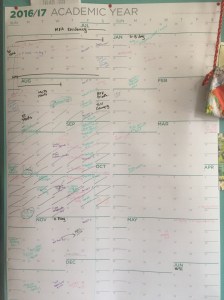
    Year-long planning to keep the Big Picture in mind.

    Year-long planning to keep the Big Picture in mind.

Deliberate Intentions: I spend 5-10 minutes each morning with my calendars. Two on the wall, a year-long, dry-erase one (available from Neuyear.net) and a weekly one (based on Jeffrey Davis’s Mind Rooms Guide). My third calendar is my online/phone calendar.

From Jeffrey Davis's Mind Rooms Guide

From Jeffrey Davis’s Mind Rooms Guide

I review what I’d intended to do yesterday, figure out if  I need to change today’s plan. Then I take a square of pretty paper and jot down rough time guesstimates for each activity and adjust if my total is more than the time I have available. Note: the process of setting up a year-long calendar will get another post. That’s a Big Process.

Notes . . . to action

Notes to action!

Direct Interaction: I scribble all over my books, my drafts, the feedback from my MFA supervisor. It’s the way I think. When I’m done, I put a big sticky note on the front cover of the book or the first page of the draft or the feedback sheets, and I jot down what I want to do next: type into ss draft ASAP. Type into “ideas file.” Ignore until after winter break. Re-read in June 2017. Submit to WHR by Nov. 30. These go into the Daily Integration pile.

Daily Integration: I allot time each day to tackle the accumulated direct interaction pieces. The pile of these isn’t so high that it’s wobbling, but I have yet to eliminate it entirely.

It has taken me YEARS to get here. And every single week, there’s at least one day where I completely, and I mean completely, fail. Maybe because the book I’m reading is so good I ignore everything else for the day (Like So Long, See You Tomorrow by William Maxwell. And The Throwback Special by Chris Bachelder.)

I’m befriending failure; all that therapy has gotten me to the place where I can forgive myself, take a nap, or just go straight to bed and start again the next day.

I’d love to hear how you organize your writing life–and if you occasionally verge or cross into chaos, how do you extricate yourself? Share with us in the comments.


Today I went live at The Write Practice . . .

. . . as a guest blogger. What fun! Check it out at The Write Practice blog.

Thanks to Joe Bunting and his terrific Write Practice team for giving me the opportunity. I’ll follow this post — about similes — with another one or two about metaphors later this year. Onward!