Helloooo, Bagels! Or, I want it all.

When we moved from Boston to Blacksburg, 20+ years ago, I had a “quality of life” checklist. It included access to the New York Times and a particular brand of chocolate. Both were available at that time; tellingly, a daily NYT is no longer available (tho’ Sundays edition is) but the sheer variety of chocolate available now has increased by a factor of ten. You can get organic, you can get fair trade, you can get single-source, you can get flavors: cocoa nibs, burnt caramel, candied bacon. Quality of life indeed!
Hello Bagel is on South Main Street, a few doors down from the Vintage Cellar.

Hello Bagel is on South Main Street, a few doors down from the Vintage Cellar.

However, until this past Monday, there was no decent bagel shop in Blacksburg. There was a spot about ten years ago that folded. There are frozen options. There’s a supplier that comes to the farmer’s market and the local food coops.

So when I heard about the “soft” opening of Hello Bagel, I set my alarm for 6:15 and I stumbled to the car in the dark and I drove ‘cross town and I paid for still-warm bagels and a cup of coffee and lo, it was almost a religious experience. It certainly restored my faith in the virtue of rising early.

And here’s the rub, for me: the only reason Blacksburg now boasts a bagel shop is that this small town ain’t so small anymore. (When we arrived in ’92, I could get anywhere in town in 10 minutes, tops. Today, I plan on twenty, or thirty if I want to be able to walk into my meeting instead of run (yes, big-city dwellers, I realize that’s not a “real” commute). I miss the small town I moved to.

BUT: if there weren’t so many people here, the writing workshops I’m offering (another shameless plug: The Joyful Quill) wouldn’t have enough participants to come alive. The writers’ groups I work with would have no new faces.

And those those who live in Real Cities will point out: uh, you do live in a small town. They’re right, of course. And so am I. Blacksburg is small. It used to be smaller. And it’s smaller than it (probably) will be in ten years.

Holding both these perceptions without denying the accuracy of either one acknowledging that more than one thing may be “true” is uncomfortable: we want Our Way to be the Right Way. If Other Ways are equally valid, then what does that make me? Wrong? I don’t want to be wrong!

A colleague recently shared an observation of me as “too worried with what other people may think.” I can’t argue. More often than not, in any given group of people, I am more interested than others in considering the possible ways my actions, or the actions of my group, may be perceived.

And don’t the Great Writers ignore what others think? Wield a machete through the thicket of conventional writing? What if Virginia Woolf had done nothing but worried about what people thought of her work? No Mrs. Dalloway? Perish the thought!

But I’m not aiming for Great Writer status. I’m aiming for sustaining my self through my writing. I’m aiming for connecting through well-crafted stories. I’m aiming for providing a writing space where people leave feeling *more* like writing than when they arrived. I’m aiming for accepting people where they are as writers, not labeling some “good” and the rest “bad.” *

I want it all: a town where I can get a terrific bagel and arrive ten minutes later at my writing group, with said bagel still warm, its schmear of cream cheese a little melty.
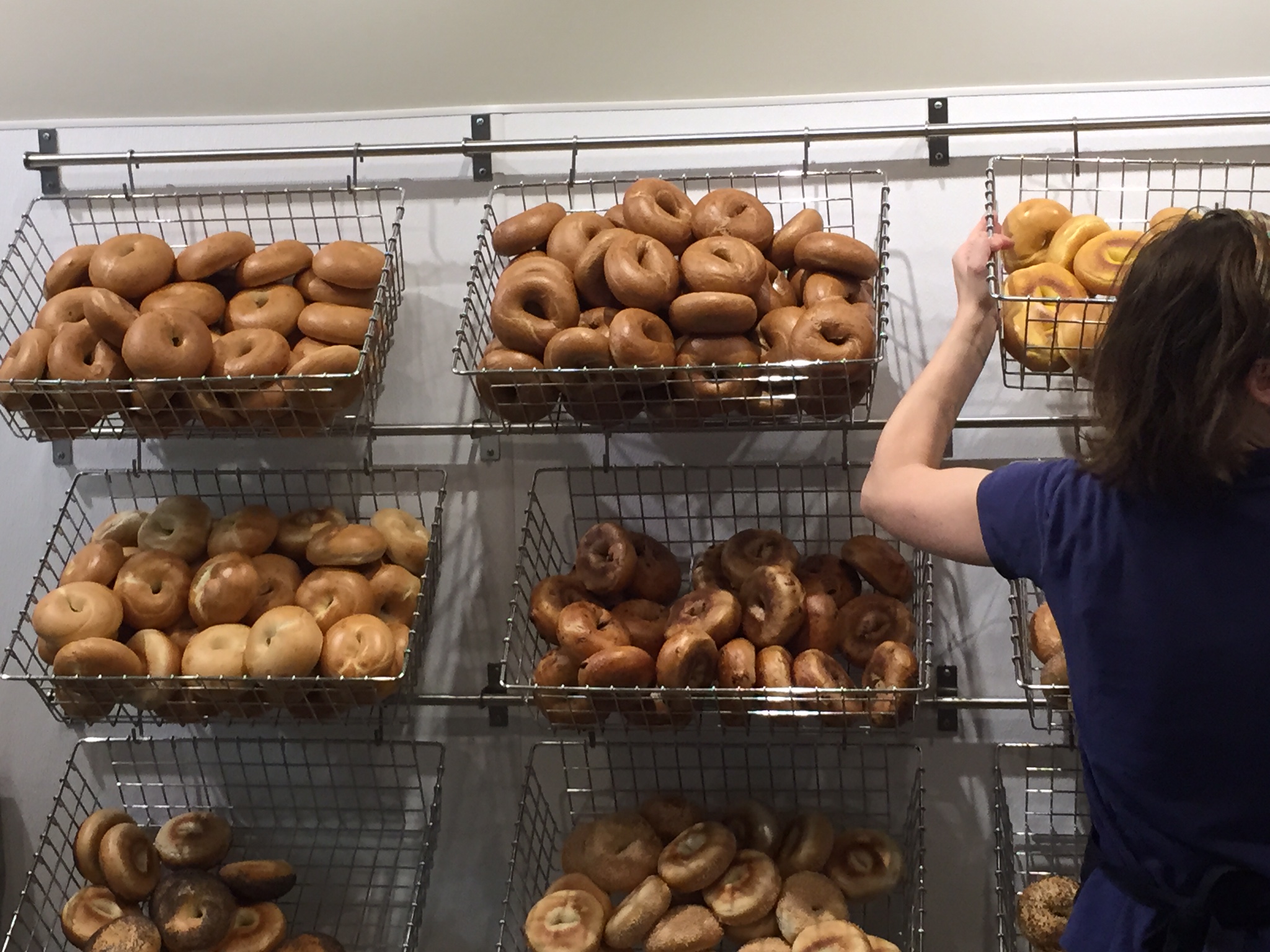
Bagel flavors galore!

Bagel flavors galore!

I’m not gonna get it all. I am gonna enjoy sitting in the middle of it all, noticing the contradictions inherent in my big small town, in writing with and against conventions, in considering what others may think, and deciding if and when to cast it aside.

There’s a lotta bagel flavors out there. I’m gonna try them all.

*I can hear the critics thrashing and gnashing: but some writing IS better than others! There are so “right” and “wrong” ways to write! And I agree: for publication, you betcha there are standards. I also note that standards deemed James Joyce’s Ulysses obscene. Standards pilloried Kate Chopin for The Awakening. We want it both ways but that’s a tough row to hoe: be a Great Writer that ignores standards AND adhere to the conventionally-accepted “right” and “wrong” ways of writing or your work won’t see the light of day, and your career will be kaput. I’m all about figuring out what we want to say and saying it to the best of our ability but hey: eyes wide open, folks. Every rant is not genius, today’s anointed geniuses may be tomorrow’s remainders, and every unpublished, half-way decent writer who keeps getting up early, making coffee, and setting their thoughts down, on anonymous paper in an anonymous house in an anonymous life — they are countless. I don’t know how to fit them into this paragraph. But I honor their attention to their writerly selves.

Shameless self-promotion: reading

Tomorrow, Thursday October 9th, I’ll be one of six readers in a virtual reading hosted by the magazine Under the Gum Tree in honor of their third anniversary. Details below; the piece I’ll share is a “flash” creative nonfiction piece titled After. It’s based on writing about my mom’s journals that I did for a Priscilla Long workshop in 2012. Whee!

Thursday, October 9 at 6 p.m. PDT (9 PM EDT)

It will be broadcast live online via Google Hangouts and that means you can watch from anywhere with an Internet connection. Just click on this link:

http://underthegumtree.us2.list-manage.com/track/click?u=d092cccd976e0c27416b6175a&id=ad36d7a8fd&e=bf3a6ed342

If you’re able to make it, please let the editor, Janna Marlies Maron, know–she will be hosting the event and would love to give you a shout out. You can let her know by emailing her at info@underthegumtree.com, or let her know on twitter at either @justjanna or @undergumtree.

Mama’s mocha

Bollo's!

Bollo’s!

It is no secret that my favorite coffeeshop is Bollo’s. It’s my favorite for lots of different reasons: its long, narrow floor plan (I can hide at a back table for productivity, or sit up front for socializing — half the town, the interesting half, comes into Bollo’s). It’s my favorite because of their oat fudge bars, and the music (staff-chosen and thus never-the-same, and never canned), and the scattering of magazines (Food and Wine, Good Housekeeping, Gourmet, Traveler) and the long church pews that run down the western wall, and the exposed brick and the fragrance that floats from the back, of baking bread and Thursday there’s danish and Friday’s  cinnamon rolls are the size of a toddler’s head. Mostly it’s my favorite because the mocha is a teensy bit different, every time I order it.

Starbucks and other chains pride themselves on providing customers the same experience no matter where they are. A Starbucks mocha in Middlebury should be the same as a Starbucks mocha in Miami. And for the most part, it is. And I love all my mocha brethren, hallelujah.

But in Bollo’s, depending on who’s behind the counter pulling espresso shots, I know I’ll get a subtly different drink. When it’s Yasmin, it’s perfectly bittersweet. When it’s Felicia, it’s perfectly balanced. When it’s Renee, it’s perfectly hot. Each of their mochas is perfectly perfect.

Tea, magazines ...

Tea, magazines …

Mochas are on my mind because the latest Poets & Writers has all sorts of information about MFA programs, and in my brief perusal of its articles and advertisements, I found myself thinking: the vocabulary used to market these programs could be the basis for an excellent drinking game. How many pages before we see the word deepen? Or inspired, supportive, strengthen, world-renowned, community, or distinguished? We’ll be tipsy before we get past the table of contents, and buying total strangers a morning-after mocha by page 33. It strikes me that creative writing degrees — or at least the marketing for them  — are like a Starbucks mocha: excellent basic product but the same product, everywhere.

I have a nagging suspicion that the marketing is, in part, aimed at people who write but don’t feel they can claim the title of writer because they lack an MFA. And/or because they’re not published. And/or because they have no desire to be published [gasp] — they’re writing for themselves or their families, so they’re not “really” writers. The list of reasons these folks aren’t writers is pretty long. If they have published but they aren’t famous, they’re not writers. If they have published but they don’t make any money at it, they’re not writers. If they don’t want to publish, it’s just a little thing I dabble with …. If they “just” keep a journal, they’re not writers.

But what else to call someone who writes, who writes for their own reasons, who writes to discern their reasons, to name, to mourn, to celebrate, to untangle?

A writer is someone who writes.

In many ways, it doesn’t matter what brings us to the page or empty screen, or who will read those words. If we lay our words down across that blank expanse, whether we leave a faint trail of our selves, or a swath of trampled ferns, we’re claiming our place in the world, giving shape to our lives as writers.

Now, if we want your words to resonate with an audience beyond ourselves or our families, we’ll probably have to work on the craft of writing — and there’s lots of good books for that, and non-MFA-affiliated groups. And MFA programs. Steve Almond has a lot to say about why MFA programs are a good thing.

Writing is not a Starbucks mocha. It’s a personality-infused, slightly-different-every-time-but-perfect-every-time mocha. It’s what we make of it, not what anyone else tells us we should make of it.

back of bollo'sWrite if you love to write. Do with it what you want.

Make your very own mocha.