All works are equal

I’m not going to throw my hat into the ring of commentary-on-Ferguson. I’m not going to think about how there-but-for-the-grace-of-god-go-I in regards to random violence. I’m not going to imagine the pain of Brown’s parents. I’m not going to listen to the estimates of when the elephant will become extinct (most likely in my lifetime. I’m broaching 50, so you can do the math).

I am going to remember that I asked Priscilla Long, in regards to her Work Inventory, why she didn’t note where her pieces are published. Because, she said,I have a body of work I want to do, and it doesn’t matter where it’s published. All works are equal.

All works are equal.

I am going to remember the giggle I couldn’t suppress while waiting to board airplanes this summer, when the gate agents called the “first class/priority” passengers to come through their priority boarding area. Which means those passengers walk over a rubber-backed 3×5′ piece of polyester carpet atop the regular carpet, to the left of the “boarding area” sign. They walk over this piece of carpet and they get to sit down first and they get to sit in seats that are a bit wider and if the plane blows up or disappears they get to lose their lives. Just like everyone else.

All works are equal.

I am going to reflect that on the day Captain Byers died in Iraq, my local obituary page held death notices for Catherine Cupp, Alma Frey, Goldie Gearhart, Lillian McClean and James May. I am going to assume that each person left behind a “to do” list, an unrequited love or two, and others who will remember their frown, their laugh, their bad puns.

All works are equal.

I am going remember that Michael Brown’s status as a young black man headed for college is a distraction from our disgrace.

All works are equal.

I’m going remember that the effect an essay, poem, screenplay, or novel has on any one person is as much, if not more, about the person reading than the work itself.

All works are equal.

I’m going to work today.


To write, perchance to produce?

World Cup Cafe

World Cup Cafe

I returned to Taos for the third consecutive year last week, for the Taos Summer Writer’s Conference. It’s a highlight of my year. It’s a highlight because it’s in the desert southwest; because its attendees are, to a one, interesting, informed, and intriguing; because it’s an excellent “reset” button for my writerly self; because it’s near Taos’s World Cup Cafe; because the World Cup Cafe serves a mocha borgia; because I feel like a brilliant writer after a mocha borgia; because when I fell like a brilliant writer I am a more productive writer.

Productive writer. An abstract concept that toddled into my thinking three years ago when I first read Prisicilla Long’s must-have-if-you’re-a-writer book, The Writer’s Portable Mentor — an abstract concept that steadied itself and began walking, sure-footed, during the time I worked with her (for the second time) at the Taos conference this year.

Prisicilla Long's book ...

Prisicilla Long’s book …

Long, like Macklemore, notes that the greats aren’t born great. They’re great because they paint/write/practice a LOT. Long suggests writers make a “list of works,” an inventory to track their pieces’ completion dates, where they’ve been sent, and when they’ve been accepted. In The Writer’s Portable Mentor, she says,

The list allows you to see the work you’ve done and it signifies respect for work done. It allows you to track your yearly production. It allows you to find any given piece to take up again. The list gives you a practice that you now share with those high-achieving creators who do quantify their works. (Georgia O’Keefe, 2.045 objects; Edouard Manet, 450 oil paintings among other works; the American painter Alice Neel, about 3,000 works; dare we mention Picasso? — 26,000 works; the remarkable short-story writer Edith Pearlman has published, according to her website, more than 250 works of short fiction and short nonfiction. That of course, does not tell us how many works Pearlman has composed.

I have a modest list of works that has grown incrementally for the past three years. And I do mean incrementally, because I haven’t been able to focus on more than one writing activity each day: if I’m generating a new short story, that generative free writing takes all my writing time. Ditto editing and conceptualizing.

But this year, for the first time, I managed two, sometimes three, types of daily writing during the conference: generative, editorial, and conceptual. And I did this because I told myself, per Long’s advice, that I only had to do it for 15 minutes. Those 15 minutes, for five days, yielded a found poem, an improved short story, and several roughed out story concepts.

I’m sure this capacity was enhanced by the total absence of my Domestic Goddess responsibilities, Engineer Hubby, our two sons, the dogs, the cat and that pesky groundhog in the backyard — a lot of my writing is done while it appears I’m daydreaming, and there’s no daydreaming time in my Real Life. Nonetheless: I’ve managed the 15 minute practice every single day, for a week, so I know I can make progress on several fronts simultaneously.

Here’s to slow, steady and productive. May it be so.

I’m not myself when I’m not at home. For which I am grateful.

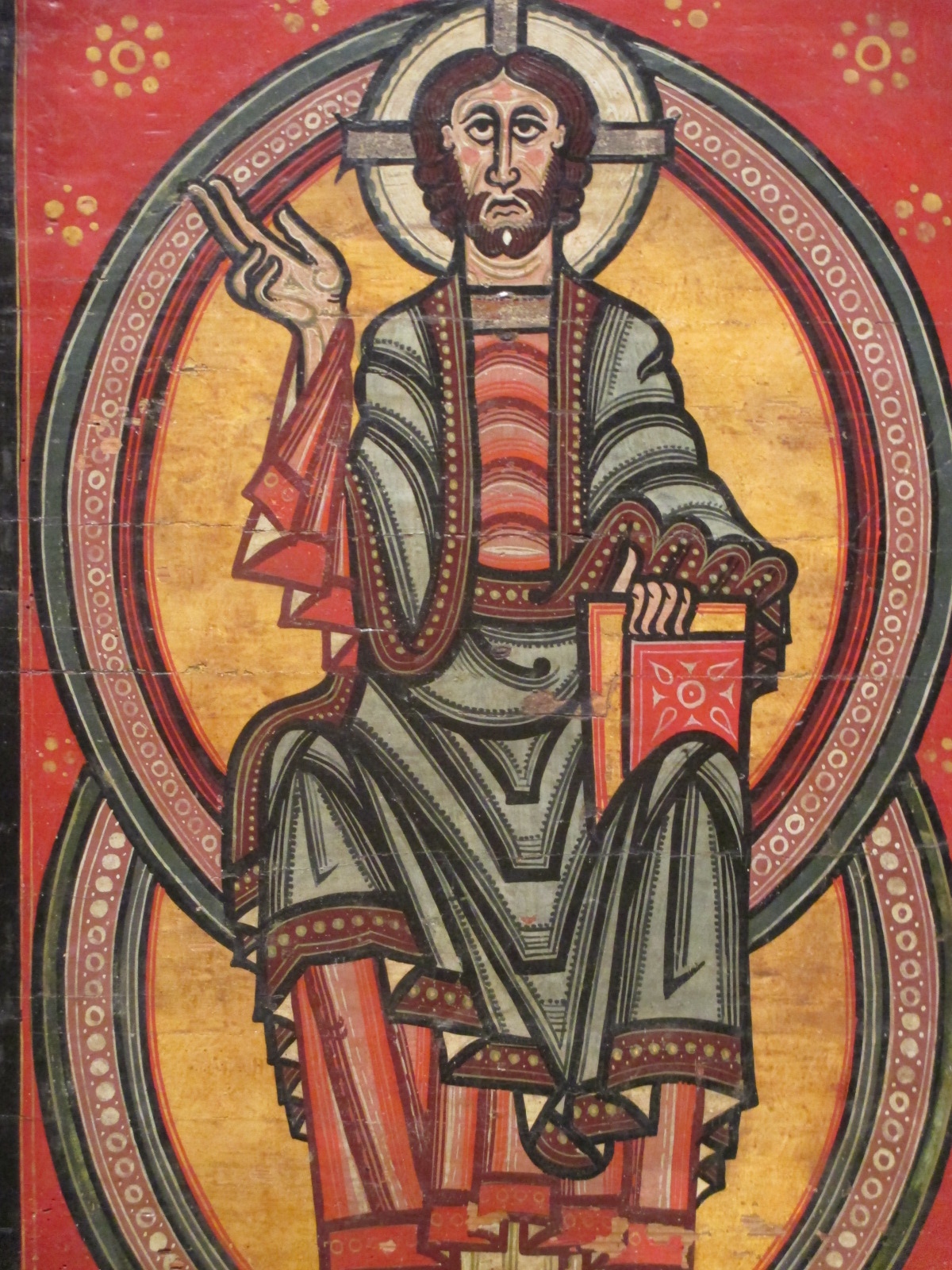
Fresco from Spanish Romanesque church

Fresco from Spanish Romanesque church

I had the good fortune to spend eight days in Spain for family vacation this June, the latter four in Madrid, a Big City with the expected hordes of tourists like ourselves, and the Prado, and churros, and late-night dining at outdoor tables. Madrid was hot, but “it’s a dry heat,” said the tour guide.

I will testify: it was a dry heat. So dry that toweling off after a shower was hardly necessary. So dry that I bought an extra tube of body lotion and depleted it. So dry that my curly hair didn’t curl.

At the risk of seeming weirdly obsessed with my hair, let me note that for better and for worse, while I was growing up (my formative years!) the reactions of strangers and friends to my unruly curls heightened my already-extreme self-consciousness of adolescence to a point of mild hysteria about the frizzes — I didn’t see another caucasian person with hair like mine ’til I was 25 years old.

But I digress: my hair changed, dramatically, in the dry heat of Madrid. I’ve been to deserts, lived in one for three months during a field study program, but never had it go so straight. By the afternoon, it dangled, limp and disinterested, into my eyes. Obscuring my view of Spanish men society.

While stumbling about thus blinded, I nonetheless caught glimpses of the locals talking, eating and drinking on a wildly different schedule from my American one. They have a light breakfast of espresso and maybe a pastry, because they were up late the night before. They work a bit (those lucky enough to be employed — Spain’s unemployment rate hovers around 25%), have another espresso and snack at 11, then break at two for lunch and/or siesta. They return to work from 4-7 PM, and eat dinner after that. Itty-bitty toddlers stroll with their parents until 10 or 11 in the evening; those without children head to clubs or bars. As my 16 y.o. put it, “up late at night, nap in the afternoon: this is a great schedule for a teenager, Mom!”

I’d read the guidebooks about Spain before going and knew what to expect. Being in and amongst that daily routine, however, was like standing next to the speakers at a live concert instead of listening through earbuds. Anyone who’s traveled or lived in a non-American country has probably shared this experience.

At the risk of stating the obvious, watching myself slip into a different lifestyle, be it for only a few days and only during vacation, I tiptoed into my brain’s quiet little side room of “what if.” What if I’d been born in a country less hell-bent on self-improvement and less interested in acquiring stuff? What if my hair hadn’t been that big a deal during those formative years?!
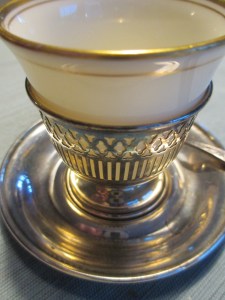
Grandma's espresso cup

Grandma’s espresso cup

I’m old enough now, and enough at peace with my life, to indulge in speculation without triggering regret that will in turn trigger life-choices-analysis-paralysis. Thus, I noted in my journal those elements of Spain that nurtured me. Some are vacation-dependent: It’s easy to manage siesta time without daily life, simple to stay out late when the dogs don’t need to be walked. But I found a short, doable ritual to bring home, too.

In the morning now, I sit in quiet with a (teeny tiny) cup of scalding-hot espresso, without reading the paper, listening to the news, or even reading a book. Just sipping, tasting, and swallowing. It takes five minutes (10-12 if you include espresso-making, which is not as snooty-patooty as it sounds and does NOT have to cost a thousand dollars for a snooty-patooty machine!). I use my Gramma’s pretty espresso cup. I stir in a scant spoonful of sugar. I finish, rinse the cup and spoon and I’m done.

Perhaps this is a ridiculously small new habit; perhaps if I had been born into a different time and place I would be weirdly obsessed about a non-hair aspect of my physical self; perhaps if I weren’t born into this time and place and culture I’d never travel and never know the difference ANYway so what does it matter?
Gaudi's church. I bet he had espresso every morning.

Gaudi’s Sagrada Familia church. I bet he had espresso every morning.

I believe it matters to be taken out of our normal routines and shown different approaches to everything because we are so interestingly, almost infinitely different. Because it’s fun.

Because when we are reminded that our habits are creations of time and space and place and not, in fact, Deep Truths, the door of possibilities is cracked just that little bit wider. You never know when that bit-wider is going to let in a big amazing don’t-know-what-it-is-yet that will blow the door off its hinges and change everything.

Here’s to paying attention to small actions every day, and opening ourselves up. Here’s to doing so in our writing, too. May it be so.