Val’s Strategies vis-a-vis Social Media

English: Infographic on how Social Media are b...

English: Infographic on how Social Media are being used, and how everything is changed by them. (Photo credit: Wikipedia)

I haven’t posted *all summer* — and it didn’t occur to me until I read this great post by my writer colleague Val Brooks that I realized I should have given y’all a heads-up: “I’m taking a time out to frolic offline in the summer’s sunshine, and then a derecho will leave me without power for the better part of a week and then I’ll be traveling and traveling more and paying bills late and unable to put fingers to keyboard.”

I’ll return to more regular posting within a couple of weeks, but her suggestions are too good to delay passing them on. I particularly like Part III, where she gets down to tangible suggestions, but Parts I & II set the stage.

Vanity, thy name is … self-absorption

I lived in Boston for four years, between college and grad school. Near the end of that time, my roommate asked if I didn’t think, in the coming  years, that I would tire of my Saturday morning ritual of brunch and reading the New York Times cover to cover. I had probably been waxing irritatingly rhapsodic about the pleasures of the crossword, pancakes and coffee at Johnny D’s.

The New York Times Book Review

The New York Times Book Review (Photo credit: Wikipedia)

I cannot remember how  my twenty-something self answered. But after enjoying brunch this past Sunday AM with my 11 y.o., and then reading all of the NYT on our front porch with the dog curled beside me,  my answer is No. This sequence of earthly pleasures does not bore me.

Perhaps it’s not tiring because of its irregularity. Perhaps it’s not tiring because although the generalities are the same, the particulars (where brunch is eaten, what brunchy-foods are consumed; the current events, scandals, and books reviewed in the NYT) are not the same. Perhaps it’s not tiring because my personality prefers sameness to novelty. Perhaps it’s not tiring because I like to perceive myself as a foodie with literary tendencies: a sort of vanity.

No matter the reason I choose, it’s of my own making: it’s whatever story I choose to tell myself. And for decades I have told myself that my kinky, curly hair is ugly (this post touches on my neurosis during the Farrah Fawcett era), an encumbrance to be minimized.
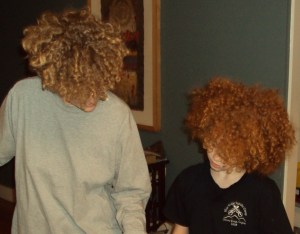
Boing boing curls!

Then aforementioned 11 y.o. emerged onto the planet with curlycurlyRED hair. Had it on day one, has it now. As it grew, its fuzzy frizziness developed into what a friend describes as boing-boing curls. H’mmm. I wondered if my hair — cut short for convenience and to minimize use of Very Expensive Curl Suppressing Product post-shower —  would do the same. My hair stylist (a veritable hair genius, Doty at Inside Out Salon) thought it would, and after eighteen months of haircuts that were more trims than cuts, it has, in fact developed those boing-boing curls.

It’s also attained enough length to try a “keratin treatment.” I splurged and asked Doty to do it. What the heck. It would wear off in five to six weeks and Doty assured me it would loosen my curls.

Curls begone …

A keratin treatment has several steps; the most relevant is the final one, where the hair is flat ironed. When Doty finished, I didn’t recognize myself. While it was fun having straight hair for a day, I was unsettled to discover that when I looked in the mirror, I saw a boring, brainless American consumer. I’ve conflated my wild hair with creativity and discernment.

Even more interesting to the writerly side of myself was the reaction of my friends when I washed my hair and the stick-straightness vanished, replaced by the looser curls Doty predicted. “Oh!” many (not all) of them said. “The curl came right back.”

To my eye, the curl had not come right back. The curl was very different. The curl was loose, almost lank. The curl had to be enhanced with a curling iron. The curl wasn’t kinky, but smooth. The curl was lovelier, doggone it! But this vanity wasn’t affirmed  by my friends. They saw curl. (See end of post for side-by-side photos of curl.)

Fascinating!, and both humbling and liberating. All that effort, and the day after, not many folks can tell the difference. H’mmm. No one *cares* what I look like. I am reminded of John Gregg’s welcoming comments at Vermont Studio Center in 2011: most of the people in the world are working for pennies a day. They DO NOT CARE that you are here at the studio center, agonizing over the composition of your painting or your essay. You are free to do what you will; perhaps it may further human peace or understanding, perhaps it will never leave the four walls of your studio. But if you have the privilege of time to engage in creative playwork (to change your hair texture), do so without self-censorship, and without expectation that anyone else out there gives a rat’s ass (will notice your smoother, softer curl). Do it because you love it, because it slakes your thirst, because it keeps you sane.

And do it because it calls us to examine our assumptions about what appearance indicates. Tattoos, piercings, baggy jeans, baseball caps, heavy makeup, age, skin color, gender — I hazard to guess we all have our own ideas about what a person with any one of those characteristics is “like.” And I hazard to guess that our ideas only skim the surface of the totality of their humanity, emphasis on surface.

Of course initial impressions are important (see this article about “the Naked Face” by Malcolm Gladwell for interesting info about how quickly we can register others’ intentions) but engaging with each other is more important.

pre-keratin curls

Let’s practice suspending judgement. Let’s practice talking past our hairstyles, tattoos, piercings, and clothing choices. Let’s practice seeking the glimmer beneath our surfaces. The most interesting stories lie beneath.

post-keratin curls … but does it really matter?

I think I might be snob …

Description= Cover page of the Book Snob à l'e...

(Photo credit: Wikipedia)

… but in a good way, an inclusive way, not a “members only” way. This first occurred to me when engineer hubby and I were given a list of books our reading-above-grade-level son “should” read, and I looked at the list — great books! all of them! Charlotte’s Web (nice essay about this classic in Sunday’s NYT Book Review), the Narnia series, Roald Dahl galore — and I thought, *every* kid should read these books, or have these books read to them. EVERYONE benefits from stories.

I also believe everyone benefits from a touch of beauty every day — a single tulip in a mason jar is enough, or if tulips are scarce, snip a pretty yellow dandelion — and even before the beauty, everyone benefits from nutritious food and a safe place to sleep and enough clothing and work that satisfies them … and, and, and.

Yet we are so veryveryvery busy making sure we have all the proverbial books on our proverbial “should” list we often neglect to invest the up-front time in the habits and practices that will sustain the beauty, the neighborhoods where we’d want to sleep, the skill to darn the holes in our favorite socks, etcetera.

This is a picture of a purple iris flower in d...

Photo credit: Wikipedia

This struck me as I walked up the steps to my son’s public middle school — currently in an older building in the next town over since the high school’s gym roof collapse necessitated a shuffling of the student body. Beside the steps up to the main building, a clutch of irises are blooming their indigo heads off. Not one or two tall straggling pedigreed snooty patooty flowers but good old fashioned your-gramma-had-’em-in-her-backyard irises, enough of them that it’s obvious to even this amateur gardener that they’ve been there for years. Decades, most likely.

Carved stone letters of this school are set into the steps. Obviously cut by hand and painstakingly placed, I know not how, into the cement.

When was the last time you saw a new building go up with a handsome, solid sign? Or with timeless plantings rather than fast-growing shrubs? I don’t know that I ever have. The faux stone accent walls in one of our town’s Recent Big Developments, mostly vacant since its completion at the start of the recession, are crumbling already, bits falling off. It’s four years old.

Makeup collection.

I have no time for make up! Photo credit: Wikipedia)

I understand the desire to get it done faster and sooner.  If I didn’t spend twenty minutes looking up synonyms and origins for verbs like “sit”, I mutter while scurrying through the grocery store, I wouldn’t be late for every bleepin’ thing! I would have time to put on makeup so I could look good while I was pondering etymology -a word I still have to double check to make sure it’s not the one that means “study of bugs.”

Those are both probably true statements, but like the decades-old irises, the stories that have insisted on blooming year after year through various drafts, revisions and edits, provide sustained and sustaining beauty. It’s not so easily evident as a flower, and of course writers have to share their work for the beauty to be evident but when a colleague reveals that your story has brought tears to her eyes, or an acquaintance gifts you with a free coffee for the “interesting ideas” in your essays — those are evidence of the blossoms, sure as a literal flower.

As importantly, when the words a writer has labored over opens another person to a willingness to share their vulnerabilities, we deepen ourselves and our communities. How else do we move beyond our surfaces but through shared acknowledgement and recognition of our shared secret struggles? These openings can become the touchstones upon which our lives rest. The gifts of attention and honor we give each other by learning how to say what we mean in our hearts, and to listen to others heart-hopes — our willingness to share and receive secret struggles — these are the flowers of effort. And they can blossom for decades if we only bother to put them carefully in the earth and tend them.

me and my friend Denise ... from years ago

What else do we have, but each other?