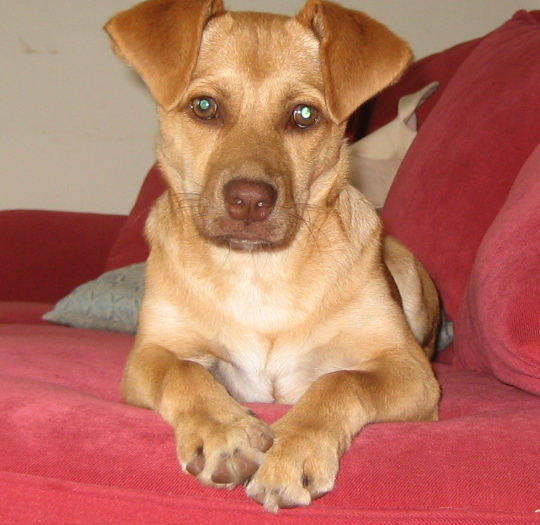
Walking in the Woods: Playing with Metaphor

The dawg I luuuuv

As most of you already know, I am in love with my dog Penny in the way only someone who was “dog-deprived” as a child (my dad was allergic) can be: I love her eyes, her floppy ears, her stump of a tail, the color of her fur (a new copper penny, hence her name), her wiggly ecstasy upon my return home – everything.

I also love taking her for walks, and walking her is one of the few things I make time for every day, rain, shine, wind, sleet, snow, sun, humidity, cold, drizzle (yes, she wears a coat because otherwise, short-haired mutt that she is, she shivers).  I don’t feel it’s fair to only allow a dog outside to “do its business” (a hilarious euphemism, though perhaps much of “business” in the economic sense is peeing and pooping as well).  So. I walk the dog.

Because I enjoy seeing places change with time,  I repeat a few dog walk loops: woods to bike path; longer walk than usual along the main road (sometimes with a stop for a tasty beverage at the coffeeshop); to the old apple tree at the once-was-a-farm park adjacent to our woods.

Big trees of the woods; photo by Anne Jacobsen

The woods are my favorite. Its trees are probably 60-80 years old and provide a backdrop for our cluster of houses. The topmost branches sway dramatically in the winds that bring the cold fronts. I am chronically astonished they remain connected to the earth in the big gusts, and still need to reassure both my sons that their roots are very very deep. “No, the trees are not likely to fall on our homes,” I say. Hoping I’m right.

I unleash Penny in the woods and she dashes after squirrel! Deer! Chipmunk! Fox?! And I mosey along behind her (or trot, if I’m running late).

Mushroom in the woods

The woods are full of surprises. There’s a hollow tree stump containing a wad of tin foil and three golf balls. The work of a crow, I believe. There’s a very small area where rocket flowers grow, on the slope to the creek. I haven’t seen it anywhere else. Mayapples run riot in the spring; mushrooms of all types and sizes — from enormous puffballs to tiny, brilliant orange ones —  multiply in late summer and early fall. Moss expands and contracts along tree trunks depending on humidity and temperature.

The trail we humans have etched runs up and down the slopes, with gentle switchbacks; the deer’s tracks, obvious in winter, run perpendicular to ours.

Every year I am certain that this spring’s first tender green and this fall’s sharp crimsons have never, NEVER, been so lovely. I know I’m forgetting last year’s palettes, but I don’t mind. I’m fine with letting today be the prettiest day ever rather than lamenting that it doesn’t compare with those gone by.

But this year is the first time I can remember being caught unawares by the trail’s disappearance under the drifts of leaves.  [Warning:  obvious metaphor for writing practice is beaten to death in the remainder of the post.]

Fall arrived in fits and starts this September, an early cold drizzly couple of days followed by warm temperatures and sun enough to ripen my last few tomatoes and encourage the foxgloves to produce a last cluster of blooms. The leaves turned all the stereotypical colors and shone against the fall sky’s blue dome. In mid-October the trail remained visible despite some accumulation of the trees’ cast-offs. My footfalls, and those of my fellow hikers, kept it relatively clear.

Then a cold front screamed in and tore the leaves off the branches: the next day the trail had vanished. Did I usually walk between those two trees or skirt them? And what are those trees? Without their leafy cloaks, I can’t hazard a guess. The rocks that bump up from the earth, the tree roots that lace across the path: all invisible, hidden. I stumbled once, twice, thrice and though I managed to keep my balance, these thoughts sluiced through my mind:

  1. I don’t know these woods as well as I think I do.
  2. Thank goodness I’m not of an age to worry about breaking a hip if I fall. Yet. This led to:
  3. Will I ever be too old to walk in the woods?
  4. Will I walk in the woods regularly when Penny dies?
  5. I don’t want Penny to die!
  6. I don’t want to die. Yet.
  7. This is a metaphor for my writing life …

I played with the hidden trail as metaphor …

  1. I don’t know my writing as well as I think I do (one of my latest drafts “birthed” a skinny, opinionated rural Virginia girl-woman whose sister is sneaking out at night to bury roadkill: I’ve been thinking about someone who buries roadkill for years, but not her sister, who is dominating the story!).  My writing path is obscured just as quickly when a metaphorical storm blows through and I have to tend to my family rather than my writing (the flu, allergy shots, doctor appointments, etcetera: all those “leaves” flew down at once and I was away from my writing for a week and when I sat down again I was utterly … lost).
  2. I’m still young enough to write although I find reading glasses enormously helpful … this leads to:
  3. Will I ever have hands too arthritic, reflexes too slowed, eyes too cataracty to NOT write?
  4. Will I continue to write when I don’t have to squeeze it in between family duties? Sometimes not having much time really lights a fire under me.
  5. I don’t want to not have the desire to write
  6. I don’t want to die. Yet.
  7. Perhaps my writing practice is a metaphor for my life …
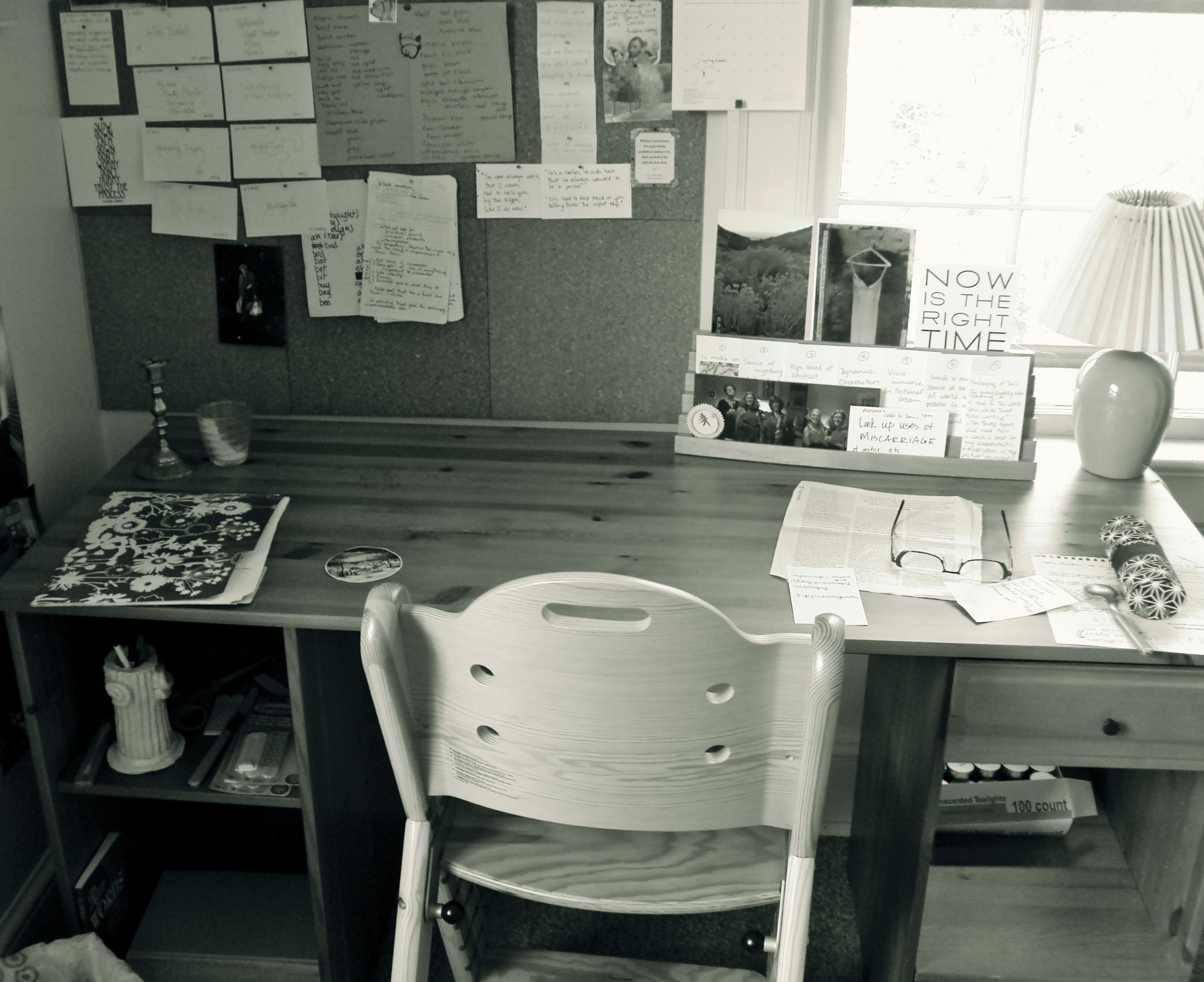
Writing desk 2011

The days are good when I can see my way clear – with or without stumbling – to time at my writing desk. I trust – I have to trust! – that if diminishing eyesight and worn-out ligaments impact my ability to “walk” my writing path, I will figure something out by putting one proverbial foot in front of the other, perhaps stumbling, but more often than not catching my balance. I trust that aging’s inevitable questions of “what now?” will arrive with winds strong enough to transform the trail in ways I can’t yet know, and that when those days arrive they, too, will be the most gorgeous days I have ever seen. In a different way. Perhaps while wearing Depends. But still gorgeous.

Why am I crying in my car?

Sing

Singing! Image by ktylerconk via Flickr

When I get behind the wheel, I’m a driver who sings along with the radio, or her iTunes playlist. It’s one of my small pleasures in life. It embarrasses my children, I’m not sure what my hubby thinks of it, and my neighborhood awarded me a “most likely to sing in public” award, so it’s hardly a private predilection, though I think of it as so.

But I hide my emotional response to songs. (Unlike my emotional response to some stories. It’s family lore that mom couldn’t finish her up-til-then fabulous out-loud rendition of A Christmas Memory by Truman Capote. Or the scene in Kathi Appelt’s book The Underneath where the mother cat dies. I cry just thinking about that.)

“One of Us” by Joan Osborne choked me up last week while I was stopped in traffic on my way to ferry the 13 y.o. to his cello lesson. Good grief, I chided myself. This is hardly a question that should provoke weeping!

The song was released in 1995, placing its rhetorical question (“What if God was one of us?”) well before 9-11, before the Virginia Tech shootings – before all sorts of events that have changed the way we “do business,” at least in my neck of the woods, at least business having to do with how we regard each other as citizens: Are you patriotic enough? God-fearing enough? Where I live, plenty of local government bodies pray before they open their meetings, and the prayers aren’t typically interfaith. They are predominantly Christian. What if God were sitting in the audience, waiting to give her-his two cents worth on the latest zoning ordinance? What if God were Muslim? Jewish? Or … agnostic, uncertain which interpretation of herhimself to endorse?

Singing

Summer songbird! Image by Pam's Pics- via Flickr

Which led me to … which interpretation of my self is “me”? Am I who my extended family thinks I am – keeper of my mother’s  journals & letters? Am I “just” a housewife? I feel like my mother role is non-negotiable, though I know plenty of women ditch it in favor of – well, a myriad of different things. Mostly involving silence and solitude. (See Anjelica Huston’s provocative portrayal of a mother in The Darjeeling Limited.) I choose to be wife and friend, though of course both those roles have dormant seasons and dry spells along with summer songbirds.

I heard an interview on NPR with Gustavo Perez Firmat a Cuban-American poet who feels betwixt and between. While my writer self has the (dis)advantage of mastery over only one language, I still feel alien amongst non-writers. Not friendless, exactly, but – one step removed. And subsequently a bit lonely. I’ve been wishing I were more “normal” so I could  be  . . . more normal.

Plus, I’m done (as in sick-to-death-of and have-revised-enough-times) with my novel and no new short story ideas have whispered in my ear and I’d rather shoot myself in the foot and run ten miles to a hospital than contemplate another novel.

So. I’ve been thinking, enh, maybe now is a time of life when you need to focus on being mom and wife and friend and community member. I caught a virus that laid me low enough to need antibiotics, and then my 10 y.o. got sick and needed allergy testing followed by multiple doctor appointments for a weird rash (idiopathic poison ivy, the cure being prednisone, this boy who can run a sprint triathalon with virtually no training, yeah, put him on steroids and . . . you do the math).

And then …  there was the Trifecta Weekend.

Back in July, when I took myself away for a retreat week , I signed up for the James River Writer Conference in Richmond, Virginia the first weekend of October. I put it on the calendar in ALL CAPITAL LETTERS and I announced to my family that I WOULD attend this conference. I reserved a hotel through Priceline. Nonrefundable albeit affordable.

Then the 13 y.o.’s soccer schedule was announced. Tournament that weekend. In Richmond.

image from Wikipedia

California ... a long way from Virginia.

Then the triathalon the 10 y.o. wanted to run this fall because he was too young last year was … on that weekend. In Richmond.

Then engineer hubby found out his big contract wanted to have a ribbon cutting ceremony that weekend. In California.

I yielded to reality. Even with the help of friends it was going to be, uh, impossible for me to spend a couple of days at a writer’s conference AND get my kids everywhere they needed to be. I didn’t have to go the conference, I told myself. I was focusing on my wifemotherfriendcommunityparticipant roles anyway, right? Besides, my writing excitement had dissipated. I would be better off managing my kids’ schedules. Chauffeuring, making sure everyone had enough water and bananas after their physical exertions.

Then engineer hubby’s trip was delayed. Due in large part to a disheartening explosion in the lab, but he wouldn’t be on the west coast that weekend, a silver lining of sorts. He decided to race in the triathalon as well.

Then the conference organizers re-arranged some things so I could still “pitch” my novel in a one-on-one meeting with the agent of my choice. I couldn’t attend the first day of the conference, but the second was do-able.

And so we went. Two cars, two bikes, tri-shorts and tops, one soccer ball, one set of cleats, two squirmy sons, a gazillion water bottles and bananas, the husband and I, and a printout of directions because “Poodles Hudson” the GPS has been flaky of late.

I had a blast at the conference. I bought ten pounds of books. I soaked up ideas about the sacred and profane from an interview between Joseph Williams and Karl Marlantes. I heard from memoirists about their families’ reactions to their stories. The agent liked my pitch. I walked back to the hotel in the autumn’s warm late afternoon light and didn’t go straight up to the room. I sat in the coffeeshop and laid plans for a return to my writer self. Turns out I do have a few story ideas knocking at the door. But they weren’t coming ’round while I was busy trying to be like everyone else.

from Wikipedia

Franz Kafka

The opening session I attended included this quote, attributed to Franz Kafka: “A non-writing writer is a monster courting insanity.”

Not exactly flattering, but accurate.

I’m (re)discovering that I have to recommit myself regularly to writing. I thought I knew enough about “practice” to practice what I preach. Turns out I don’t.

I’ve had to coax myself into resuming the discipline of morning pages. I’m wearing out the buttons on my timer for ten-minute writes. Because it remains, after all these years, scary to sit down in front of a blank page.

Scarier to court insanity, however.

What’s something that fills your creative well, something you don’t do often enough for yourself?

Image via Wikipedia

The monster within ...

Schedule it! Do it! Halloween aside, our communities and our selves — all of them! — don’t need half-dead spirit monsters. Life is too short to dawdle: all of us need to sit up, take notice, and write our stories, be it with literal pen and paper or music or dance or fabulous meals for our families and friends, or telling the Town Council what you really think about the latest zoning ordinance.

‘Cuz there are times when our other roles have to be front and center.

But my writer self is at my core. And when a song – or a book – makes me cry, I need to listen closely and wrestle a bit with the why and wherefore of my tears’ origin. Perhaps we all do.

If it doesn’t work, HIDE IT.

Image via Wikipedia http://commons.wikipedia.org/wiki/File:Vick_6.jpg

Michael Vick

I don’t know whether you live with, or are yourself a football fan, but earlier this week, a lot of the media talked about Michael Vick’s concussion. There’s been increased awareness and studies made public about the brain damage football players suffer throughout their lives, from the “micro-concussions” they experience with every collision through to being knocked completely unconsciousness, and coaches and athletes are starting to take notice.

Michael Vick is a conversation starter in my family, in part because we live in Blacksburg, where he attended Virginia Tech before turning pro. Before the dog-fighting and subsequent jail term. We marveled at his prowess on the field, and make no mistake: though I didn’t know a first down from a touchdown when I met my husband, I’ve become minimally knowledgeable about the sport in the decades since. I’ve spent my share of conversational fuel on the debate about the sport’s brutality, the kinesthetic intelligence, the racism, the scandals, etcetera. And I feel comfortable admitting that when a player catches a hail Mary pass and runs it to the end zone, or a running back jukes out the defense and sprints away, it’s as lovely to behold as a masterful novelist’s opening paragraphs.

Nonetheless, when we had a son, I declared, “he will never play football.” Most of the “nevers” I’ve declared as a parent I’ve had to eat at some point. “I’ll never drive a minivan.” Took me six months with two kids to choke those down. “I’ll never let him eat dessert first.” Well, the dessert was carrot cake but the principle was definitely violated.

Son #1 heading for contact with the ground ...

However, with football, I’ve held firm. Despite my oldest son’s passionate love of the game. Despite his friends’ participation. Despite his promise he would “only be a kicker, mom, and there’s a penalty if they get tackled.”

I wavered briefly once, when the Town’s rec league offered a summer sandlot camp. But during the week I wavered, I watched my kid’s soccer game with a friend, who’d played football in college. After we’d all winced on the sidelines at a particularly painful collision between our eight-year olds, he commented, “soccer is a contact sport. Football is an assault sport.” My gut instinct confirmed with his assessment, the wavering steadied and hasn’t returned. That’s one permission slip I’ll never sign.

The connection to art-making, the practice of writing?

Well, holding fast to depriving my sons of football has entailed a LOT of conversation about why they can’t play, which for me, when they were younger, was simple: I think it’s bad for your body, especially your head. You get hit too hard. This wasn’t a lie or even stretching the truth: I don’t think our skulls are designed to protect our brains from repeated, hard, sudden impacts.

Mama Bear and Cub

Image by Bob Jagendorf via Flickr

And now the evidence is bearing out this mama bear’s gut instinct. Helmets are being redesigned, the NFL has been shamed into participating in studies to track brain damage on its players. Vick says he feels fine but a neurologist will ultimately decide whether and when he plays again.

Ever have a “mama bear” reaction to an idea but you didn’t follow up on it and a year later you saw the picture you imagined hanging in a gallery? A book review  describing “your” plot? A poem glowing with “you”  imagery?

Yeah, me too.

I’d like to blame circumstance (see above re: conversations with children about why they can’t play football. Multiply by 24/7, on a range of topics and time for creative effort has vanished like a will-o-the-wisp!). I’d like to say I’m just not as “good” a writer as those who did publish.

Image by Xevi V via Flickr

Fingers + toes = 20

But that’s a cop-out. The number of “genius” level writers alive at any one time on the planet can probably be counted on one’s fingers and toes. The number of those actually writing can be counted on fingers only.

Truth is, I was afraid. Afraid my ideas were stupid. That I couldn’t do it.

Release from fear is one of the presents Time brings in its  gift-jammed goodie bag. Although I’m beginning to experience very real physical limitations —  my eyes are going, my short-term memory isn’t so much memory as an exercise in frustration (and the poem “Forgetfulness” by Billy Collins describes this PERFECTLY), I need more sleep than I used to, my muscle mass is waning and my neck hurts if I spend too much time at the computer  —  I have figured out that fear isn’t the reason to ignore my gut.

The visual artist Gary Stephan put it beautifully during a presentation at Vermont Studio Center in March 2011. If an image or an idea captures you, play with it. Paint it. Write it down. In other words, don’t “think” yourself out of the idea that it is or could be, Art. Yes, with a capital “A.”

And then the kicker: “If it doesn’t work, hide it.”

Image by Andreas-photography via Flickr

Private

Duh! I can just squirrel away that horrific haiku under my old address book. Or burn it entirely. No one need ever know I thought road kill rhymed effectively with bode ill. Even if I were a famous writer, my missteps would be entirely my own. Unlike pop singers and football stars, writers and most other artists have the privilege of trying out new stuff, and failing, privately.

While I relish the cloak of relatively invisibility my creative work allows me, I’m also grateful for the very public triumphs, mistakes, restitution and subsequent acceptance onto the Philadelphia Eagles that Vick’s journey teaches. It illustrates what my Unitarian Universalist (interim) minister Alex Richardson calls “praxis,” a variation on my idea of practicing creativity:

Humans make promises to each other.

We break those promises.

And then we renew the promise and try again.

It’s not a painful stretch to:

Artists make promises to themselves … to sit down and do the work of creation.

They fail, opting instead to eat, train for 5Ks, read, blog (!), raise children, cook elaborate five-course French dinners, do the crossword in under 5 minutes – anything rather than stare down another blank page.

They swallow literal or metaphorical aspirins and show up at the desk again and sharpen their pencils and put the words down again.

A decade later we may or may not have published those words. But we’ve got ‘em. It’s up to us to decide whether and how to market our words in the slippery-fast current of today’s world of publishing.

Image by Cookieater2009 via Flickr

a writer's best friend

Sit down. Write. Erase it. Forgive yourself. Start again.