
I’ve been nose to the cliched grindstone since February, working on the required 30+ page essay for my MFA. I ran the gamut of emotion about the essay itself (hated it. feared it. dismissed it. cowered before it. fell in love with it.). And I learned more than I realized I hadn’t known, a terrific lesson in both humility and craft.
Humility because: I’m fifty. I’ve been reading and writing since I was four. Not intensely, or with a clear purpose, necessarily, but steadily. I’ve read lots of books about craft. I’ve read a lot of fiction. Some poetry. I’m not un-schooled, I’m not stupid, and I’m not afraid of pain: I birthed one of my children without painkillers and have managed to parent the second one without pharmaceutical assistance. Yet.
All that said, I had no idea what it was like to dedicate myself to my writing with the intensity that this essay demanded. I’ve been getting along just fine in my low-res MFA by devoting three to four hours per day, on average, to meeting its requirements–writing and reading and annotating.
But the essay: my first two efforts, totaling almost sixty pages of writing, were not coherent. There was no thesis. It was muddled. I was muddled. I could not figure out what to do differently: I was working as hard as I had my first two semesters. What the what?
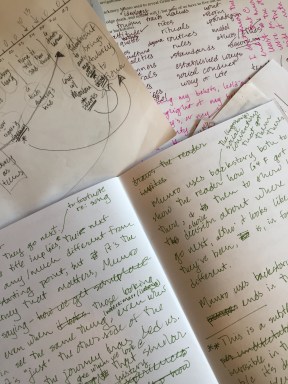
Essay drafting bits and pieces
The essay’s deadline began to loom, sounding like Darth Vader, waking me up at three AM but not letting me fall sleep before midnight.
So I got greedy. I got greedy about my time. I quit cooking entirely, didn’t scrub the toilets, allowed the dust and dog hair to gather into balls the size of watermelons. I said no to volunteer requests, no to the weeds in the backyard, no to a potential client.
I went to my favorite coffeeshop and I took the table in the back and I sat and I wrote for six to eight hours a day. I bought multiple cups of coffee and various snacks to fuel me, but what I really did was get very very very greedy about my time.
I know, I know: I am, after all, doing a low-residency MFA: aren’t I already greedy? But this is the first time I placed my need for writing time above everything else. Everything. I disassembled the words I had already written and I spent two days just thinking about the “thesis” in my introduction. And then I rewrote the introduction and then I revised it four more times, reading it aloud each time. (Yes, I looked a little crazy at that back table. I didn’t care.) Then I went fishing in my first two drafts for the parts that addressed my now-coherent thesis, and roughed in what was missing. And then I set out to fall in love with each section, and then each sentence in each section and then each word. That takes a ton of time.
Is my essay a work of art? No. Do I love it? Yes. Did I learn a ton of writerly craft stuff? Yes. All the pedagogical reasons to write an essay were definitely met.
And maybe learning how to be greedy about time is an implicit pedagogical goal, too. Because here’s the thing: having spent six to eight hours a day on my writing, I want more days like that. I’m not gonna get them with the frequency that I forced to meet the deadline, but now that I know what I can do when I get greedy with my time, I want more time. I have spent a half-century putting my writing below all the other sh*t that fills our lives. Statistically speaking, I don’t get another fifty years. And I can tell already that I’m slower than I was a decade ago.
So, yeah, I’m greedy. Yeah, I’m privileged to be able to have this time. But what good comes of my guilt, my angst, my hand-wringing, my volunteering for activities I resent for taking me away from writing desk? How does the suffering of the world abate when I turn away from what brings me to life?
I’m lucky this lifetime. Thank you, dumb luck. And yes, I’ll take all I can get.

 These days, as I aim to figure out how to manifest my ideal of “democratic citizen,” I’ve been leaning on the wisdom of those leaders and activists and students of history who wrote down their stories. My favorite tome at the moment is


 the Art of Practice