Tag Archives: Creative writing

Craft Matters: Timing is everything. Or is it?

We whirl through our days amidst commitments internally- and externally-imposed; some weeks we have to squeeze in our writing while waiting for the doctor, the oil change, the vet and yes that is my upcoming week.

But today I read this terrific post by Noa Kageyama, whose equally terrific blog, The Bulletproof Musician, frequently addresses matters of effective practice and discipline that applies to all of us aiming for artistry. This one looks at a study that examined how efficient learning is when it’s done at night rather than in the morning.

Don’t mess with my morning mojo, my writing muse whispered. You can’t write after three in the afternoon! I will not watch the sunset with you! 

No matter how gorgeous the sunset, my muse thinks evenings are Not a Good Time to Write. I'm going to see if she's right.

No matter how gorgeous the sunset, my muse thinks evenings are Not a Good Time to Write. Is she right?

 But the *evidence* shows that people learn and remember their learning more efficiently and effectively if they tackle it in the evening, go to bed, and then practice again in the morning. Huh. Is my muse really so special that she will be exempt from evidence-based research? Actually, is this really about my muse, that elusive spark of inspiration, or is this about the simple learning and practicing of craft?

I think it’s the latter. If I want to get the compound-complex sentence down cold (my current craft focus, inspired by David Foster Wallace’s jaw-dropping application of basic grammatical tenets), I need to learn its form and practice it.

Although I’d like to think I’m very special, I suspect that I’m no more special than anyone else when it comes to my grey matter. So based on Kageyama’s post, I am going to ignore my muse and set up some evening craft reading-learning-practicing exercise sessions for myself, followed by next-morning follow-up craft reading-learning-practicing exercise sessions.

I’ll let you know how it goes in about a month–and if you have any experiences with how you’ve learned specific writing craft, tell us all about it in comments below!
The MFA: I’m running like our cat

We have a sweet and wonderful cat, a stray who lived near my old writing studio. I gathered her up one chilly November day several years ago  — she was sweet and affectionate even when she was skinny and shivering — and brought her home to join the chaos. She has a loud purr and will nip your calves when her dish has been too empty for too long. And she loves to sit in and on suitcases. Packing for a trip? Plan an extra ten minutes to vacuum the fur off the bag. Returning from a trip? If you don’t close the suitcase after emptying it, she will sleep in it all day long.

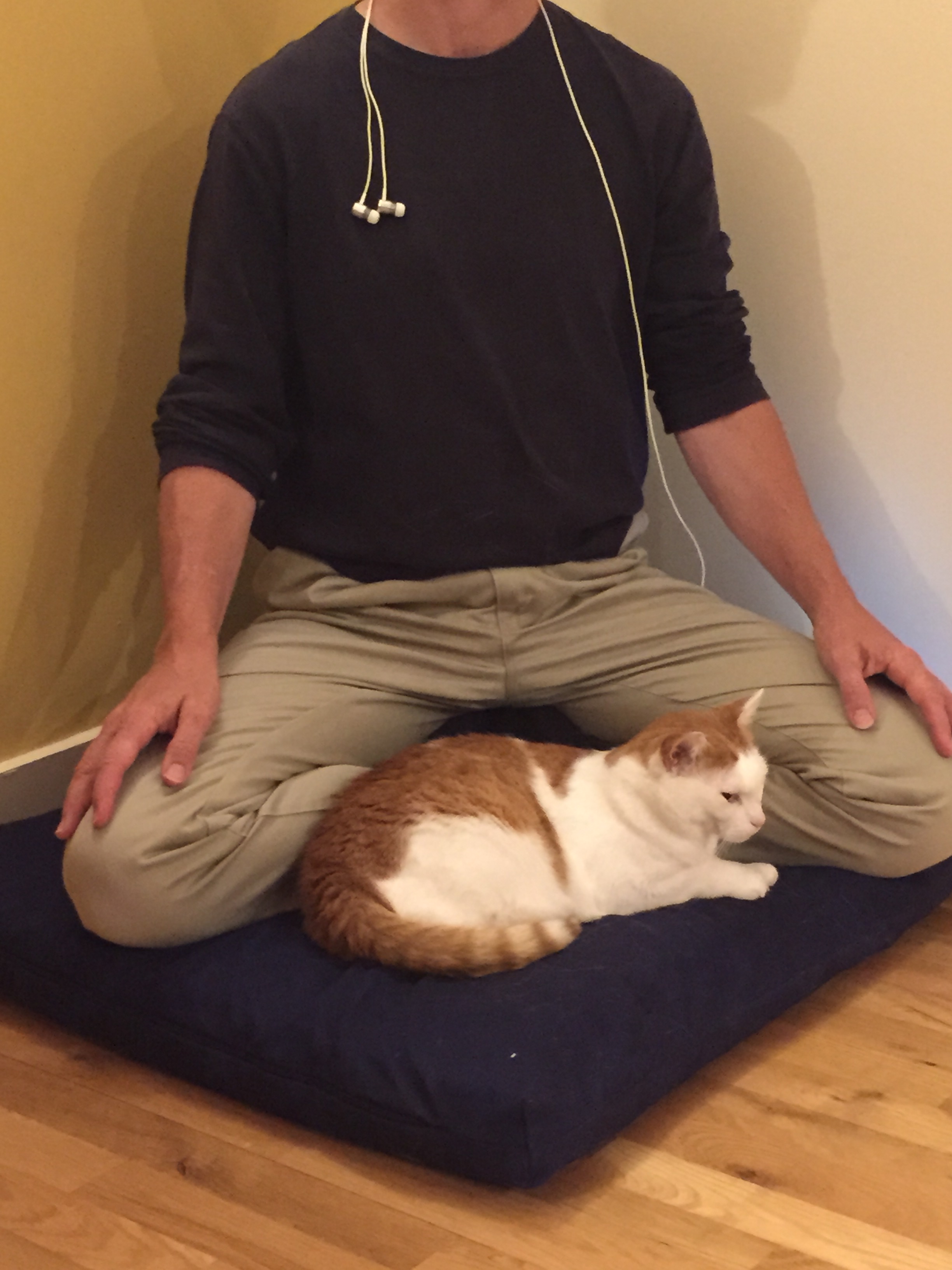
And this cat loves to snuggle up next to my husband when we do our daily meditation sit. Ok, it’s not every day, but we try. The 17 y.o. sits in the big yellow chair, the 14 y.o. & I settle on the couch and hubby sits on a zabuton cushion and the cat, no matter where she is in the house, curls up next to him. She purrs and purrs and purrs and purrs.

Meditating kitty.

Meditating kitty. And hubby.

But last night there was an open suitcase in the foyer. She had leapt into it, settled and purred and fallen asleep. Well, we said, no cat on the zabuton tonight. We all sat down and we set the timer and … there was a gentle kerthump as the cat jumped from the suitcase and then ran — sprinted — to sit with my husband. Seriously.

Please indulge me as I now sally forth into extended-metaphor-land.  In this metaphor, I am the cat, my life is the suitcase and the snuggling-while-meditating is my writing. I like my life. It has comfy places to sit and I like to sit and write. And when the Warren Wilson low-residency MFA program offered me a place in their program I of course happily accepted.

And here’s what surprised me: I had no idea I would want to sprint to an MFA program. I love writing and my application obviously was an indicator that I’d want to enter the program. But when I began listening to some of Warren Wilson’s downloadable craft lectures, I shifted from “this will be good,” to “this is what I have wanted to do and didn’t even know it holy cow I can’t wait!” An entire hour of lecture about the semicolon! An hour and a half on internal versus external turning points in fiction and poetry! When I described the bliss I experienced while listening to these lectures, the 14 y.o. said, “You’re kidding, right?” and I squealed, “No! No! I am not kidding. I get to study this stuff for TWO WHOLE YEARS!” He was aghast. I was giddy.

It’s a bit weird that our cat runs to sit with us during meditation. Loving to think about and talk about semicolons is a bit weird. (OK, maybe a lot weird.) But I am looking forward, with an almost animalistic delight, to immersion in this new-to-me writing community. Long live the weird!

May you find and run to your (little bit weird) delight today, too.

To write, perchance to produce?

World Cup Cafe

World Cup Cafe

I returned to Taos for the third consecutive year last week, for the Taos Summer Writer’s Conference. It’s a highlight of my year. It’s a highlight because it’s in the desert southwest; because its attendees are, to a one, interesting, informed, and intriguing; because it’s an excellent “reset” button for my writerly self; because it’s near Taos’s World Cup Cafe; because the World Cup Cafe serves a mocha borgia; because I feel like a brilliant writer after a mocha borgia; because when I fell like a brilliant writer I am a more productive writer.

Productive writer. An abstract concept that toddled into my thinking three years ago when I first read Prisicilla Long’s must-have-if-you’re-a-writer book, The Writer’s Portable Mentor — an abstract concept that steadied itself and began walking, sure-footed, during the time I worked with her (for the second time) at the Taos conference this year.

Prisicilla Long's book ...

Prisicilla Long’s book …

Long, like Macklemore, notes that the greats aren’t born great. They’re great because they paint/write/practice a LOT. Long suggests writers make a “list of works,” an inventory to track their pieces’ completion dates, where they’ve been sent, and when they’ve been accepted. In The Writer’s Portable Mentor, she says,

The list allows you to see the work you’ve done and it signifies respect for work done. It allows you to track your yearly production. It allows you to find any given piece to take up again. The list gives you a practice that you now share with those high-achieving creators who do quantify their works. (Georgia O’Keefe, 2.045 objects; Edouard Manet, 450 oil paintings among other works; the American painter Alice Neel, about 3,000 works; dare we mention Picasso? — 26,000 works; the remarkable short-story writer Edith Pearlman has published, according to her website, more than 250 works of short fiction and short nonfiction. That of course, does not tell us how many works Pearlman has composed.

I have a modest list of works that has grown incrementally for the past three years. And I do mean incrementally, because I haven’t been able to focus on more than one writing activity each day: if I’m generating a new short story, that generative free writing takes all my writing time. Ditto editing and conceptualizing.

But this year, for the first time, I managed two, sometimes three, types of daily writing during the conference: generative, editorial, and conceptual. And I did this because I told myself, per Long’s advice, that I only had to do it for 15 minutes. Those 15 minutes, for five days, yielded a found poem, an improved short story, and several roughed out story concepts.

I’m sure this capacity was enhanced by the total absence of my Domestic Goddess responsibilities, Engineer Hubby, our two sons, the dogs, the cat and that pesky groundhog in the backyard — a lot of my writing is done while it appears I’m daydreaming, and there’s no daydreaming time in my Real Life. Nonetheless: I’ve managed the 15 minute practice every single day, for a week, so I know I can make progress on several fronts simultaneously.

Here’s to slow, steady and productive. May it be so.