Tag Archives: creativity

The Origami Penis

Disclaimer: there will be hardly any origami, and no male genitalia available for viewing or download in this post.

Origami fun

The “origami penis” phrase arose in a meeting of the New River Writers Project, when one of our members mentioned that his life is “too boring to blog about.”

No, some of us countered, your life is  not boring. Tell us about your eccentric clients! (I shall only reveal that he is a handsome fella of a certain age whose living demands he have extensive public contact. Not literal contact. Get your mind out of the gutter!)

The blog would have to be anonymous of course, someone added. You couldn’t reveal where you actually live. That’s true, he nodded. He paused. “I could call it the Handyman of Love,” he said.

Vulnerable

Vulnerable (Photo credit: S.H.CHOW)

We howled and moved on to the critiques, one of which was for a writer who’s hesitant about starting a blog without having at least a dozen posts ready to go. Another member joked that she didn’t really want to know what anyone else thought and would she have to receive comments on her blog? It was at this point that I slipped into writerly observation mode.

Ten of us were circled around a table; we all have stories in various stages of “polish” and professionalism; we write for a variety of reasons; we range in age from under-thirty to over-sixty.

But the humor within which we conceal-revealed our concerns led me to guess that we all share a worry that maybe we’re not unique enough, not literary enough, not funny enough, not interesting enough. Is this because we’re not in NYC? Because we don’t have MFAs from prestigious writing programs? Why do we think our lives don’t meet the “interesting-enough” criteria?

Spinning Tanoura

Spinning Tanoura (Photo credit: puthoOr photOgraphy)

Robert Boswell noted, in the Taos workshop I reference here, that writers must steal ruthlessly from their own lives. Writing is an ever-spinning dance: between arrogance (sitting down and writing my stories is worth the time and energy and money!), and humility (if I want anyone to read my stories, I need critiques of my drafts). Sometimes the whirl makes me dizzy. I am a Goddess! vs. I am a sh*t-shoveler in the lowest circle of hell. And who am I to tell anyone else what they should or shouldn’t do?

I’m betting this is not a surprise to anyone who undertakes a creative endeavor. And as I write this, I’m thinking sheesh, so WHAT, everyone knows this, shut up already.
connection

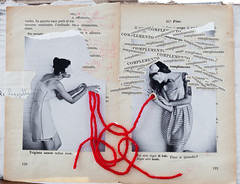
But the responses I receive to my words surprise and humble me, and that’s the thing: when we don’t share our creative acts, we don’t know what connections we’ve missed.  The what-ifs are infinite. Every kind word suppressed because I felt self-conscious, every deleted phrase, every un-remarked-upon link between X and Y: each of these might have opened a whole other path to venture down. Not necessarily a better path, or a worse path, but certainly one with more connection.

Why do we shy away from those connections? I have found that people, on the whole, tend toward decency and kindness. Those who don’t are great “testimony” for our writerly selves. Tell your stories!

That fellow-writer with a boring life? He speculated about making origami penises as part of a handyman of love business and sent us all into a borderline-hysterical orbit of giggling. He inspired my words here. Connections galore!
Time: is it a sandwich?

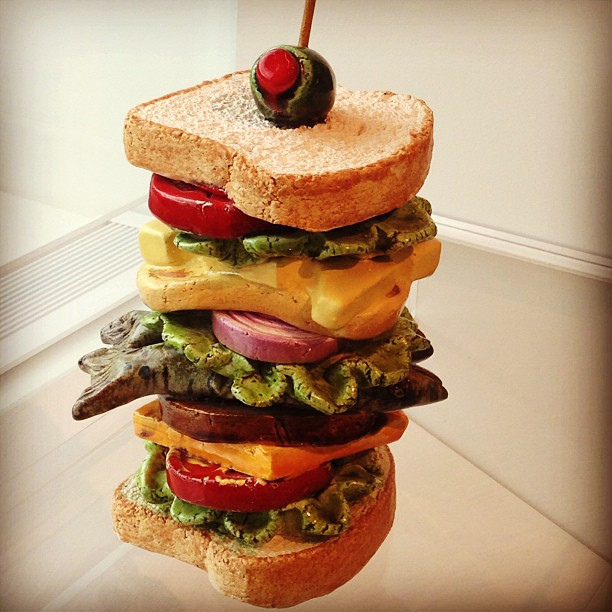
My 13 y.o. waxed somewhat rhapsodic on our ride home from his cello lesson last week. What if time didn’t matter, he said. What if everything is happening all at once, and time doesn’t move forward like we think it does but instead is a big thick layer (a Dagwood sandwich sprang to my mind) and time travel wouldn’t take us forward or backward but just to the other layers that we’re in.

I’m not sure where he gets these ideas, tho’ it’s a good bet that his leave-no-crumbs wolf-down consumption of nonfiction helps. And Engineer Hubby hooks up podcasts about science on road trips and that helps, too. But I never, and I mean NEVER, thought about what time might be like when I was a child. I never think about it now. Except when he’s talking and then my little mind gets blown.

I think about people and why they do what they do and what would happen if they did something else and how could someone get away with shoplifting or embezzling or murder and how hard it would be to go into hiding from the mafia, and alternative outcomes for country song story lines. Usually all of these jumble together in my brain while I shower.

There are plenty of theories and studies about creativity; environment certainly has a lot to do with it, and being supported by someone who cares about you is also important (I have an informal theory that every artist has had at least one teacher who said YES! to whatever they tried) but ultimately: we are unique collections of molecules. And the organization of those molecules into the human form, the human brain, follows a regular DNA pattern book, a pattern book with a lot of variations but not an infinite number of combinations. Why do some of our pattern books lead us to think about time instead of about people? Or is the we-are-molecules-and-an-electrical-system concept too limiting, failing as it does to account for the soul, or spirit?

It has taken me most of my adult life to glom onto the fact that others are Different From Me. Profoundly, completely different. That not everyone cleans their dishes before going to bed. Or washes their sheets once a week. These dish-in-sink, clean-sheet-slackers appear to be happy, healthy, content.

Photo by Mickey Destro

Photo by Mickey Destro

These days, as I do said dishes and load aforementioned sheets into the washer, I find myself thinking: Andrea Barrett doesn’t do this. Lionel Shriver doesn’t spend this much time on domestic duties. Writers must write which means dust bunnies will be free to frolic and breed. Maybe, just maybe, if I imagine hard enough and write long enough, I’ll be able to release my inner dirty-dish-lover, and she in turn will surprise me by creating that which I cannot yet imagine: a sandwich of words, comprised of pastrami particles and swiss cheese holes and mustardy molecules, the crumbs left for the ants.

That pile in the basement …

Longed-for warmer temperatures have graced us this past week, eliciting the usual assortment of cliched remarks about the flora and fauna (crocus, daffodil, spring beauty, snowdrops, forsythia, redbud, chipmunks, baby rabbits, robins, wrens).

I undertake my version of spring cleaning: open the windows and let the breeze amass the swirling dog fur and dust bunnies into one massive fluff ball in a corner; hook up vacuum and suck up mass. I tidy and I rearrange; I sort my books and I file my papers. I stop and drink coffee and browse thru’ the Sunday paper.

In the March 20th New York Times “Museums” section, I stumbled upon Golden Age of Discovery … Down in the Basements by David Wallis. Who knew?, but some of our capital-C, Capital-I Cultural Institutions share my lowercase-d, lowercase-g domestic goddesses struggle of staying on top of STUFF.

Of course, what they discover when they go to their basement archives includes Picasso sculptures, rare war helmets of indigenous peoples, and notes from Famous People of History. I find adolescent journals, my grandmother’s account books and timesheets tracking my hours on a federally-funded redevelopment project.

ledger enlargedI’ve tossed the timesheets, but my Grandmother’s account books, with their tidy columns and itemized rows of expenses: they tell me a lot more than she ever chose to share, or I ever know to ask, about her daily life. She, too, struggled with the tension inherent in running a household and creative work. There are entries for groceries, laundry, coal, magazines, stamps. Charmingly, under “miscellaneous” there is, twice-monthly, 35 cents for roses; every three weeks or so is one dollar for “H’s candy” — her husband must have harbored a sweet tooth. There are no entries for weaving supplies though the outstanding feature of her house, when I was a child, was two huge looms. She traveled with a smaller table-top loom. She wove placemats, table runners, samplers, towels, decorative coasters, scrabble tile bags, chair coverings, bookmarks, napkins. You name it, she wove it.

I still use, daily, one of her woven bookmarks. I have always enjoyed it, and find it elegant. No polyester junk, but for-real, finely-patterened silk and linen threads. Having seen her careful accounting for the very real expenses of her daily life on this spring day, and the lack of any such entry for her artistic life, the bookmark becomes dearer.

Some of Gram's weaving

Some of Gram’s weaving

The work we do for love, the work we are privileged to do above and beyond the grunt work of daily necessity: that beauty lasts, to be held and felt and loved. On a breezy spring day, in a basement crowded with life’s leavings.

Let’s look for the treasures in our archives basements. Find whatever we’ve forgotten, whatever scraps of paper and memory may unexpectedly reconnect us, remind us, restore us, return us: to ourselves.