Tag Archives: writing

Walking in the Woods: Playing with Metaphor

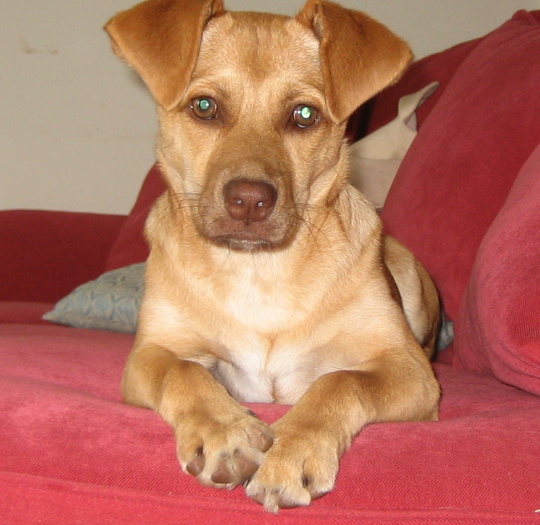
The dawg I luuuuv

As most of you already know, I am in love with my dog Penny in the way only someone who was “dog-deprived” as a child (my dad was allergic) can be: I love her eyes, her floppy ears, her stump of a tail, the color of her fur (a new copper penny, hence her name), her wiggly ecstasy upon my return home – everything.

I also love taking her for walks, and walking her is one of the few things I make time for every day, rain, shine, wind, sleet, snow, sun, humidity, cold, drizzle (yes, she wears a coat because otherwise, short-haired mutt that she is, she shivers).  I don’t feel it’s fair to only allow a dog outside to “do its business” (a hilarious euphemism, though perhaps much of “business” in the economic sense is peeing and pooping as well).  So. I walk the dog.

Because I enjoy seeing places change with time,  I repeat a few dog walk loops: woods to bike path; longer walk than usual along the main road (sometimes with a stop for a tasty beverage at the coffeeshop); to the old apple tree at the once-was-a-farm park adjacent to our woods.

Big trees of the woods; photo by Anne Jacobsen

The woods are my favorite. Its trees are probably 60-80 years old and provide a backdrop for our cluster of houses. The topmost branches sway dramatically in the winds that bring the cold fronts. I am chronically astonished they remain connected to the earth in the big gusts, and still need to reassure both my sons that their roots are very very deep. “No, the trees are not likely to fall on our homes,” I say. Hoping I’m right.

I unleash Penny in the woods and she dashes after squirrel! Deer! Chipmunk! Fox?! And I mosey along behind her (or trot, if I’m running late).

Mushroom in the woods

The woods are full of surprises. There’s a hollow tree stump containing a wad of tin foil and three golf balls. The work of a crow, I believe. There’s a very small area where rocket flowers grow, on the slope to the creek. I haven’t seen it anywhere else. Mayapples run riot in the spring; mushrooms of all types and sizes — from enormous puffballs to tiny, brilliant orange ones —  multiply in late summer and early fall. Moss expands and contracts along tree trunks depending on humidity and temperature.

The trail we humans have etched runs up and down the slopes, with gentle switchbacks; the deer’s tracks, obvious in winter, run perpendicular to ours.

Every year I am certain that this spring’s first tender green and this fall’s sharp crimsons have never, NEVER, been so lovely. I know I’m forgetting last year’s palettes, but I don’t mind. I’m fine with letting today be the prettiest day ever rather than lamenting that it doesn’t compare with those gone by.

But this year is the first time I can remember being caught unawares by the trail’s disappearance under the drifts of leaves.  [Warning:  obvious metaphor for writing practice is beaten to death in the remainder of the post.]

Fall arrived in fits and starts this September, an early cold drizzly couple of days followed by warm temperatures and sun enough to ripen my last few tomatoes and encourage the foxgloves to produce a last cluster of blooms. The leaves turned all the stereotypical colors and shone against the fall sky’s blue dome. In mid-October the trail remained visible despite some accumulation of the trees’ cast-offs. My footfalls, and those of my fellow hikers, kept it relatively clear.

Then a cold front screamed in and tore the leaves off the branches: the next day the trail had vanished. Did I usually walk between those two trees or skirt them? And what are those trees? Without their leafy cloaks, I can’t hazard a guess. The rocks that bump up from the earth, the tree roots that lace across the path: all invisible, hidden. I stumbled once, twice, thrice and though I managed to keep my balance, these thoughts sluiced through my mind:

  1. I don’t know these woods as well as I think I do.
  2. Thank goodness I’m not of an age to worry about breaking a hip if I fall. Yet. This led to:
  3. Will I ever be too old to walk in the woods?
  4. Will I walk in the woods regularly when Penny dies?
  5. I don’t want Penny to die!
  6. I don’t want to die. Yet.
  7. This is a metaphor for my writing life …

I played with the hidden trail as metaphor …

  1. I don’t know my writing as well as I think I do (one of my latest drafts “birthed” a skinny, opinionated rural Virginia girl-woman whose sister is sneaking out at night to bury roadkill: I’ve been thinking about someone who buries roadkill for years, but not her sister, who is dominating the story!).  My writing path is obscured just as quickly when a metaphorical storm blows through and I have to tend to my family rather than my writing (the flu, allergy shots, doctor appointments, etcetera: all those “leaves” flew down at once and I was away from my writing for a week and when I sat down again I was utterly … lost).
  2. I’m still young enough to write although I find reading glasses enormously helpful … this leads to:
  3. Will I ever have hands too arthritic, reflexes too slowed, eyes too cataracty to NOT write?
  4. Will I continue to write when I don’t have to squeeze it in between family duties? Sometimes not having much time really lights a fire under me.
  5. I don’t want to not have the desire to write
  6. I don’t want to die. Yet.
  7. Perhaps my writing practice is a metaphor for my life …
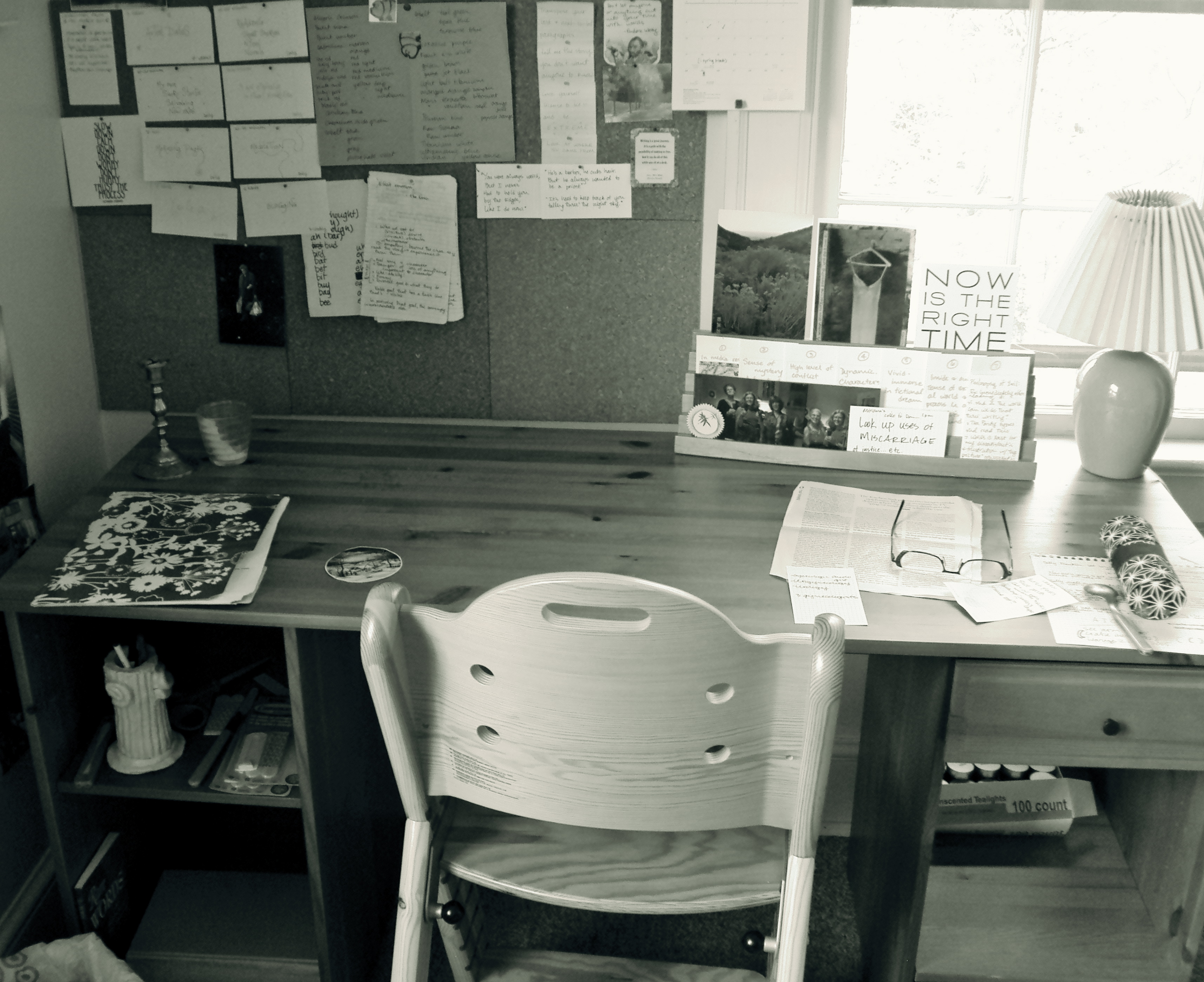
Writing desk 2011

The days are good when I can see my way clear – with or without stumbling – to time at my writing desk. I trust – I have to trust! – that if diminishing eyesight and worn-out ligaments impact my ability to “walk” my writing path, I will figure something out by putting one proverbial foot in front of the other, perhaps stumbling, but more often than not catching my balance. I trust that aging’s inevitable questions of “what now?” will arrive with winds strong enough to transform the trail in ways I can’t yet know, and that when those days arrive they, too, will be the most gorgeous days I have ever seen. In a different way. Perhaps while wearing Depends. But still gorgeous.

If it doesn’t work, HIDE IT.

Image via Wikipedia http://commons.wikipedia.org/wiki/File:Vick_6.jpg

Michael Vick

I don’t know whether you live with, or are yourself a football fan, but earlier this week, a lot of the media talked about Michael Vick’s concussion. There’s been increased awareness and studies made public about the brain damage football players suffer throughout their lives, from the “micro-concussions” they experience with every collision through to being knocked completely unconsciousness, and coaches and athletes are starting to take notice.

Michael Vick is a conversation starter in my family, in part because we live in Blacksburg, where he attended Virginia Tech before turning pro. Before the dog-fighting and subsequent jail term. We marveled at his prowess on the field, and make no mistake: though I didn’t know a first down from a touchdown when I met my husband, I’ve become minimally knowledgeable about the sport in the decades since. I’ve spent my share of conversational fuel on the debate about the sport’s brutality, the kinesthetic intelligence, the racism, the scandals, etcetera. And I feel comfortable admitting that when a player catches a hail Mary pass and runs it to the end zone, or a running back jukes out the defense and sprints away, it’s as lovely to behold as a masterful novelist’s opening paragraphs.

Nonetheless, when we had a son, I declared, “he will never play football.” Most of the “nevers” I’ve declared as a parent I’ve had to eat at some point. “I’ll never drive a minivan.” Took me six months with two kids to choke those down. “I’ll never let him eat dessert first.” Well, the dessert was carrot cake but the principle was definitely violated.

Son #1 heading for contact with the ground ...

However, with football, I’ve held firm. Despite my oldest son’s passionate love of the game. Despite his friends’ participation. Despite his promise he would “only be a kicker, mom, and there’s a penalty if they get tackled.”

I wavered briefly once, when the Town’s rec league offered a summer sandlot camp. But during the week I wavered, I watched my kid’s soccer game with a friend, who’d played football in college. After we’d all winced on the sidelines at a particularly painful collision between our eight-year olds, he commented, “soccer is a contact sport. Football is an assault sport.” My gut instinct confirmed with his assessment, the wavering steadied and hasn’t returned. That’s one permission slip I’ll never sign.

The connection to art-making, the practice of writing?

Well, holding fast to depriving my sons of football has entailed a LOT of conversation about why they can’t play, which for me, when they were younger, was simple: I think it’s bad for your body, especially your head. You get hit too hard. This wasn’t a lie or even stretching the truth: I don’t think our skulls are designed to protect our brains from repeated, hard, sudden impacts.

Mama Bear and Cub

Image by Bob Jagendorf via Flickr

And now the evidence is bearing out this mama bear’s gut instinct. Helmets are being redesigned, the NFL has been shamed into participating in studies to track brain damage on its players. Vick says he feels fine but a neurologist will ultimately decide whether and when he plays again.

Ever have a “mama bear” reaction to an idea but you didn’t follow up on it and a year later you saw the picture you imagined hanging in a gallery? A book review  describing “your” plot? A poem glowing with “you”  imagery?

Yeah, me too.

I’d like to blame circumstance (see above re: conversations with children about why they can’t play football. Multiply by 24/7, on a range of topics and time for creative effort has vanished like a will-o-the-wisp!). I’d like to say I’m just not as “good” a writer as those who did publish.

Image by Xevi V via Flickr

Fingers + toes = 20

But that’s a cop-out. The number of “genius” level writers alive at any one time on the planet can probably be counted on one’s fingers and toes. The number of those actually writing can be counted on fingers only.

Truth is, I was afraid. Afraid my ideas were stupid. That I couldn’t do it.

Release from fear is one of the presents Time brings in its  gift-jammed goodie bag. Although I’m beginning to experience very real physical limitations —  my eyes are going, my short-term memory isn’t so much memory as an exercise in frustration (and the poem “Forgetfulness” by Billy Collins describes this PERFECTLY), I need more sleep than I used to, my muscle mass is waning and my neck hurts if I spend too much time at the computer  —  I have figured out that fear isn’t the reason to ignore my gut.

The visual artist Gary Stephan put it beautifully during a presentation at Vermont Studio Center in March 2011. If an image or an idea captures you, play with it. Paint it. Write it down. In other words, don’t “think” yourself out of the idea that it is or could be, Art. Yes, with a capital “A.”

And then the kicker: “If it doesn’t work, hide it.”

Image by Andreas-photography via Flickr

Private

Duh! I can just squirrel away that horrific haiku under my old address book. Or burn it entirely. No one need ever know I thought road kill rhymed effectively with bode ill. Even if I were a famous writer, my missteps would be entirely my own. Unlike pop singers and football stars, writers and most other artists have the privilege of trying out new stuff, and failing, privately.

While I relish the cloak of relatively invisibility my creative work allows me, I’m also grateful for the very public triumphs, mistakes, restitution and subsequent acceptance onto the Philadelphia Eagles that Vick’s journey teaches. It illustrates what my Unitarian Universalist (interim) minister Alex Richardson calls “praxis,” a variation on my idea of practicing creativity:

Humans make promises to each other.

We break those promises.

And then we renew the promise and try again.

It’s not a painful stretch to:

Artists make promises to themselves … to sit down and do the work of creation.

They fail, opting instead to eat, train for 5Ks, read, blog (!), raise children, cook elaborate five-course French dinners, do the crossword in under 5 minutes – anything rather than stare down another blank page.

They swallow literal or metaphorical aspirins and show up at the desk again and sharpen their pencils and put the words down again.

A decade later we may or may not have published those words. But we’ve got ‘em. It’s up to us to decide whether and how to market our words in the slippery-fast current of today’s world of publishing.

Image by Cookieater2009 via Flickr

a writer's best friend

Sit down. Write. Erase it. Forgive yourself. Start again.

[to be said in whiny voice]: Can’t I do that later?

I have just spent twenty minutes playing mahjong, my distractionary online game of choice. There are many others out there, some even arguably related to writing, like WordTwist and Boggle but I like mahjong. I start by telling myself: three games, play only three games. Then four. Then, well, how about ‘til top of the hour. Then, I almost win so maybe just ‘til I win, ‘cuz obviously I’m on a roll!

If I were in Vegas and had a wad of cash I would rationalize myself out of both aforementioned wad and into several trips to the ATM machine. As Jeff Goldblum’s character says in The Big Chill, can’t get through the day without a good rationalization.

FLYLady’s organization system (I swear by it, tho’ my version is a loose adaptation of hers; Laura Benedict, a thriller writer, actually credits FLYLady in the acknowledgements of her first book), if you buy into it as I have via the calendar and stickers, you know there’s an “antiprocrastination day” sticker. I have placed this sticker on my calendar exactly once in the past three years, thinking, why bother, my house is reasonably tidy, I’ll get to all that other stuff when I can.

public domain

And we save these because ...

When we needed more space in our utility room, however, I stumbled across not one, not two, not three, but FOUR bottles of antifreeze, three of windshield washer fluid and TWENTY cans of paint, which I‘ve saved “in case I need to touch up the walls.”

OK, first of all, I never touch up my walls. I wait seven years then ask for my birthday gift to be hiring a painter to cover all the dirt with a fresh coat of paint. And frankly, after seven years with the same color, I change it. I will NEVER use this paint.

Could I put this stuff into the dumpster? Or did I need to take it to the dump and pay extra for hazardous waste disposal? Could I wait for a  “toxic waste pick up day” through my Town? Ugh. I needed to research my disposal options. Blerck. Screeching halt.

I needed an antiprocrastination day. I knew I needed an antiprocrastination day. I didn’t want to need it. I … put it off.

Then, we reallyreallyreally needed the extra space in the utility room, due to a home improvement project. It was no longer an option, it was a necessity.

Image by tonx via Flickr

Inspiration!

I put the sticker on my calendar and the day of, drank a Lot of Coffee before digging in, tackling not only the various bottles of various fluids of various toxicities, but also identifying the outgrown shoes, t-shirts, books, and kid debris to be given away.

I finished most of it and planned for tackling the rest of it.

I get this way about my writing, too. The pitch I don’t make, the phone call I delay, the story I don’t polish in time for a contest deadline.  Why have I not put the antiprocrastination sticker on my writing calendar?

I think because that means developing a new habit. I have plenty of blinkin’ habits, my gawd, my muse squawks, give me a BREAK, I’m tired of the work it takes to do the work! Didn’t you say writing was fun?

But effective work – even creative “work” – takes forethought to be done well, and maintenance to keep it heading in the right direction. Which isn’t to say one shouldn’t pause and assess that direction on a regular basis.

Image via Wikipedia

Doesn't she look like she needs a pick-me-up?

A friend and I are contemplating the development of workshops on “nurturing the muse” – exploring writing as both a self-reflective tool and/or as creative expression. For the first time in many years, I find myself excited, anxious, uncertain, and nervous — a teenager on her first date. Will anyone else want to do this (eg, will anyone like me?!). Do I have the ability to provide leadership to such a group? Do I want to do this?! And back to “what is the point, Shakespeare did it better” of the last post.

[If you have psychological training, insert your favorite theory here. And/or — check out this great post by the Communicatrix about the “resistor.”]

Image via Wikipedia

Life's speciality: the curve ball. Sometimes accompanied by dog spit.

My gut says I’m going to try it, though, because life’s nine innings are looking short, here in what I think of as the top of the fifth of my probable-span of years. And the pitcher keeps throwing curve balls (like, giving me two baseball-crazed sons when I know I placed an order for kids who would prefer the sports one can play with a gin-and-tonic in hand. Croquet. Badminton. Scrabble.)

Long story short: I have no excuse — no one does – to delay whatever project I imagine I’ll get to “someday.”

Take an hour to assess whether or not your project(s) is(are) still important to you. Those twelve mini stockings I was hand-stitching  for the twelve days of Christmas, when my kids were two and five? Not ever gonna finish that project.

The short stories about evil? I still think about those regularly.

I made a folder to collect those ideas in, and I’ve INKED in three days in the next quarter to look at that project. Whole writing days, five hours. I will use the Freedom program to limit my internet aka mah jong access and honor my commitment. [If you haven’t heard of Freedom, check it out. It truly liberates me from the tyrannical joy of the internet.]

Get out the stickers or markers or pens (not pencil, it’s too easy to erase) and give yourself one day a month for antiprocrastination efforts. Do NOT put this off!