Tag Archives: writing

Manifesting Kind Words–to ourselves

I recently told a friend that I no longer go to some community meetings because several of my neighbors have said things to me that I’ve experienced as deeply hurtful. “Really?” she said. “You don’t go?”

I felt off-balance for a moment: after all, shouldn’t I turn the other cheek? Extend empathy? Isn’t that what being in community is all about?

I used to think so. I used to work really really REALLY hard for community. Hours of volunteer time: physical labor, facilitation, writing and editing, organizational development. And then . . . I got a lotta what I’ll term bat-sh^t crazy hate* flung my way.

And instead of turning the other cheek and extending empathy, the habits our culture holds up as Good, I’m breaking those habits. I’m minimizing the time I spend in the same room with these folks. That’s all–I’m not sending hateful vibes or emails, and I don’t wish misfortune upon anyone. But I’m not doing what I’ve always done before. I’m trying a different response — as Amy McTear says, I’m “determin[ing] the quality and conditions of my life.”
IMG_1724

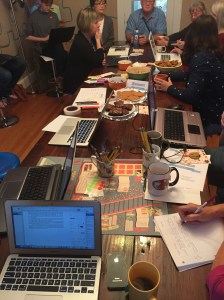
Writers treating each other with kindness . . . note the warm drinks and tasty treats 🙂


This is my real-life application of what I preach about writing. Just as our stories need audiences that honor and respect them, so do we, as people.

Treat your writing with kindness and compassion.

Treat yourself with kindness and compassion, too.

Danielle LaPorte takes this a step further: she says pleasure is power.

When you’re in your pleasure you think more clearly, you’re more efficient, you’re most certainly more creative, and you’re more loving. Your pleasure states are good for your immune system. Mmmhmm.

It can be really difficult to make pleasure a priority when we’ve got so many ingrained habits based on distraction (numbing out) and performance (pleasing others). For a lot of us, choosing pleasure would be a major life turn around. I get it.

Isn’t this all very white-privilege? Easy to talk about pleasure when you have extra resources. But what good will come of NOT moving toward pleasure? Is anyone spared suffering, is any injustice ameliorated, when we go to meetings and feel miserable before, during and after? Nope.
IMG_1769But when the people we’re working with light us up, are willing to goof around and goof up and say “sorry!” — when the people we’re working with are, in short, a pleasure to be around, then we’re on the side of positive change. (A short list of things that happened when I had fun with other people: we established the New River Land Trust; a youth group; a grassroots leadership program; a co-housing neighborhood; The Joyful Quill; New River Valley Voices; and A Fiercely Kind Word.)

So yeah, I’m moving toward people who will ask me about my intentions, as a person, as a writer, before telling me all the ways I’m wrong and bad, all the ways my words don’t convey the story I hope to tell. Because my soul feels better, and my writing gets better, when I’m with people who approach me and my words with kindness.

I hope you, too, will move toward people who are kind to you, to your stories — it’s good for you! And if moving toward kindness means moving away from unkindness, as my friend Mica Estrada explains in her “Kindness Experiment” article in Psychology Today  moving away from those who behave badly despite our best efforts does them a favor, too.

And come on over to A Fiercely Kind Word to get a dose of love for your writing.


*Hate is a strong term, and I don’t use it lightly here, nor am I gonna go into details of the words and actions that were sent my way; suffice it to say that a friend who’s an experienced psychologist alerted me to the possibility that these folks may be struggling with mental illness. She observed that their behaviors and the language of their communications is similar to that of people with borderline personality disorder. I’m currently doing a 100-day tonglen meditation practice to see if I can discern how to be kind to myself and those who may have mental illness — while it’s helpful to hear that the hate-flingers may not intend to be hurtful, the sh*t still stinks and stings when it’s flung.



A Fiercely Kind Word

OK, y’all, here’s the dealio. I’ve got a lovely new website, put together by the terrific folks at Tracking Wonder. It’s for writers who want to improve their writing craft with fiercely kind support, customized for their project, their writing challenges–because the writing process is messy, ambiguous, difficult, frustrating, exhilarating, elastic, forgiving and forbidding.

I’m a writer, so my engagement with writers through A Fiercely Kind Word will reflect my writer’s life. At this point (one more semester to complete my MFA), I’m not going to promise a koan of writerly wisdom every Wednesday. There’s no way I can guarantee a brilliant insight first thing Monday morning. Because: writing is messy, ambiguous, difficult, frustrating, exhilarating, forgiving and forbidding.

_C8A6964-Edit - Richard Mallory Allnutt photo - Lesley Howard - Blacksburg, VA - June 11, 2017

Richard Mallory Allnutt made me look good for A Fiercely Kind Word. Thank you, Richard!

When you hear from me, it will be the real dealio: my craft essays. My reflections on stories and novels. My practices. My stage of the journey, in all its messy, ambiguous, difficult, frustrating, exhilarating, forgiving and forbidding glory (or misery, depending). Sometimes, but not always, there will be a “craft frolic” at the end of my posts, giving you suggestions for how to play with whatever writerly craft element I’ve mused upon.

I’ve got a nifty manifesto you can download from A Fiercely Kind Word here; if you sign up for my Fiercely Kind Word prompts (at the bottom of this page), you’ll get five days of free writing prompts. And of course if you want to work with me, you can contact me through my . . . (drum roll!) contact page.

And I’ll still blog, occasionally, here, about the less-chronic chaos of having an half-empty nest and parenting the “baby adults” my sons have grown into since I started this blog five years ago.

Onward!

p.s. I’m still fine-tuning the behind-the-scenes components of A Fiercely Kind Word, so if you encounter any hiccups, please contact me at lesley@afiercelykindword.com and let me know.


Blog Party: Lesley’s post

For those who have no idea what “Blog Party” refers to, I encourage you to read this post to see what it’s all about. 

It’s glorious spring in my neck of the woods, and the woods I walk my dogs in is bursting with all shades of green: emerald, jade, sea-foam, M&M, spearmint. And these greens come in all shapes and sizes, from mayapple to fern to clover to rambling rose to cottonwood saplings. Each different, each thicker in some parts of the woods than others: the mayapples tend to cluster where sunlight makes its way through the thickening canopy; the ferns seem to prefer darker slopes; the saplings dot the areas where an older tree has fallen—they need the light that’s available to them in those gaps.

So many greens! So many shapes!

So many greens!                   So many forms!

And so it is with the forms that our stories may take: just as the majority of the plants in the woods are green, so many of our stories are made of words, words of all types: sacred, profane, Germanic, Latinate. And the form these stories take also varies: spoken word, poetry, creative nonfiction, drama, short story, novel.

I have been banging my head against the proverbial wall in regards to form for my writing: short stories are encouraged in the MFA program, I believe because getting a short story to “work” is a practice that can be applied to longer (and shorter) pieces of prose. But I’m only human, and I’ve worked with three- or five-act structure for years; I know Aristotle’s incline intimately, and Freytag’s triangle is my good friend. It’s like being in love with ranunculus or daisies and not noticing hyacinth and coral bells, and there’s nothing wrong with having a preference, for loving what we love.

For story structure, my love has been to include a fair amount of backstory. Last semester, while I floundered with a short story, my advisor suggested I get rid of all backstory and revise the story entirely in one scene. What?! No no no no my writer self hollered, I need backstory! At least a little bit!

I was wrong. Completely, totally, entirely wrong. When I cut out the backstory bits (carefully saving them in another file, because, well, because) the characters did and said everything necessary for the story in the present moment of the story. And in fact, once they were unencumbered by the backstory, they soared up and out and behaved in some startlingly interesting ways—the story blossomed.

Oh.

There are a gazillion ways to structure every piece of writing. OK, maybe not a gazillion. But more than three. How to become familiar with more than the major three? First learn the basics: Aristotle’s incline, Freytag’s triangle. There are all kinds of resources for this: Deepening Fiction by Sarah Stone & Ron Nyren. Imaginative Writing by Janet Burroway. The Practice of Creative Writing by Heather Sellers. In Priscilla Long’s The Writer’s Portable Mentor, page 19 has a wonderful jump-start process for an essay. Also Robert Ray’s The Weekend Novelist does a terrific job both teaching structure and providing the beginning writer with the scaffolding to complete the draft of a novel. And while learning, or reminding yourself, of the basics, read like mad. Take stories apart. Re-type them. It’s amazing how a writer’s process is revealed by simply re-typing their story. I’m doing it today with a chapter of Renata Adler’s Speedboat.

Because even if we love only some of the greens the world has to offer, our stories may demand that we expand our aesthetics. Writers are here to serve the stories that come to us, not cram them into the little boxes we’re familiar with.

Here’s to spring’s wild greeny excesses, its bounty of difference.

May your stories find their shape.