Tag Archives: writing

The Lyric Book is PUBLISHED!, and why it’s complicated …

The picture is worth a thousand words!

The picture is worth a thousand words!

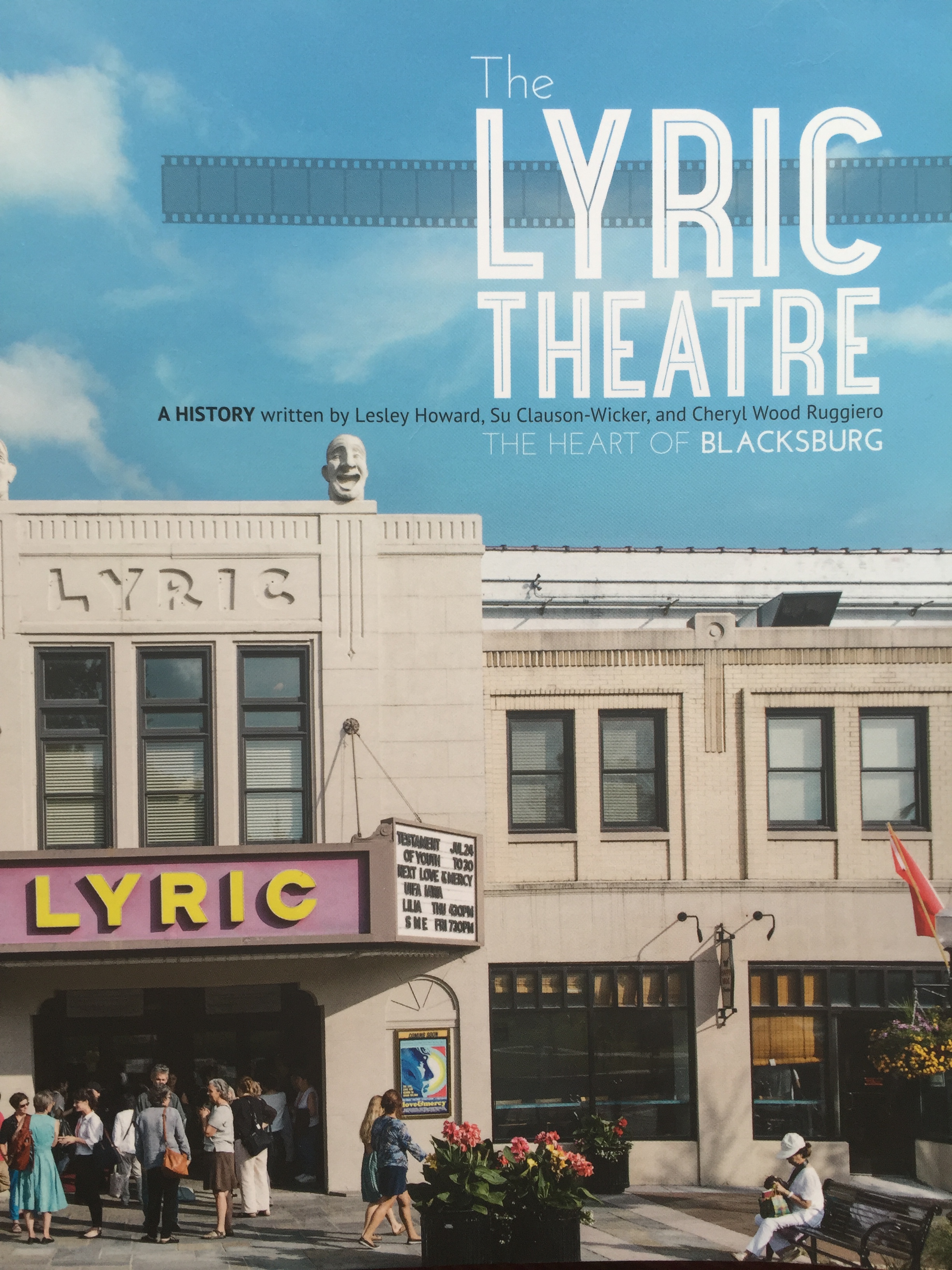
The Lyric Theatre in downtown Blacksburg has been in its current location since 1930. Its story is now available in a book that I helped write, The Lyric Theatre: the Heart of Blacksburg.

It’s beautiful to look at and lovely to hold because the designer, Christina O’Connor, is crazy good at what she does. It’s interesting because Su Clauson-Wicker and Cheryl Wood Ruggiero are terrific interviewers and researchers and writers and copy-editors. And folks have said it reads well because I did much of the writing. This is thrilling!

That said, I had an interesting conversation with a friend yesterday who asked me: are you comfortable receiving praise for this book? My answer: it’s complicated.

I love it when people love something I’ve written. But I often feel like the story has come to me; it’s not “mine” — it’s ours. I wrote it down. The story is mine only insofar as I am responsible for listening closely to what I hear and discerning the story. I am responsible for paying attention, for discipline and diligence, for re-writing for clarity and power, and for finding a home for stories. But once I’m done writing, it’s not mine. It’s ours. I happen to be the writer.

It also happens that this book was a pleasure to serve as a writer. Enjoy it! The story it tells belongs to all of us.

And may you have the chance to listen for, and share, your stories as well.

If you’d like to buy a copy of the book, you can do so at the YMCA Craft Fair November 13-15 (I’ll be there some of the time if you want a personalized copy!). It’s also available in downtown Blacksburg at the Alexander Black House, the Artful Lawyer Gallery, the Lyric Theatre, the Montgomery Museum, and Uncommonly Gifted.

Fleek, fleck, whatever; I got it wrong.

The young-to-me man ringing up my lunch order said, “That tomato soup is on point. Or as the young would say, on fleek.” (Spelled like it sounds.)

“On what?” I asked, and added, “You look like the younger generation to me.”

“No,” he said, “I was born in ’90 so I’m not the younger generation. And yeah, they say on fleek. It’s the same as saying on point.” (Which I think is really en pointe, the french term for ballet dancers when they are on their tippy-toes.)

“But why? What’s the logic of that? Where’s it from?”

He shrugged. “Kids today.”

Indeed. After supper I asked the 14 y.o., “What does on FLECK mean?”

“Oh my god mom, do you mean on fleek?”

“Yeah, that’s it. On fleek. What the heck is that?”

He doubled over, in shame or wordless laughter, I couldn’t tell. “Just don’t ever say that again, mom.” And then he hollered up the stairs to his older brother, “Guess what mom just got wrong!”

I am so of the older generation now. I like being of the older generation — I don’t worry about my looks or whether someone else likes me, etcetera. There’s a lot of freedom in middle age. And true to the stereotype of middle-aged mom, I despair about the younger generation some of the time. I’m baffled by on fleek. My hubby and I lament the screens that engage our children although in my reflective moments I think that perhaps slaughtering forests of trees for paper on which to print essays and books isn’t all that great … and how ironic that plenty of those essays and books are about how the next generation doesn’t get it because they’re on their devices all the time … and those kids in my community who went to school in t-shirts bearing the confederate flag don’t seem to have ever read a history book! How is it that they don’t grasp the complexity and nuance of how that symbol affects their fellow community members? Kids today.

Kids today! Some thing never change. And as a writer I have been struggling with whether and how to enter the increasingly-heated political frays occurring all over the place, not least in my own confederate-flag-divided community.

Adam Zagajewski 2014 in Stockholm

photo of Adam Zagajewski 2014 in Stockholm by Frankie Fouganthin — from WikiCommons

I found guidance in Susan Sontag‘s essay, “The Wisdom Project,” which centers on an extended exploration of the book Another Beauty by Adam Zagaejewski, a Polish writer:

Life, when not a school for heartlessness, is an education in sympathy. The sum of stories reminds us that in a life of a certain length and spiritual seriousness, change — sometimes not for the worse — is just as real as death.

All writing is a form of remembering. …

That memories are recovered — that is, that the suppressed truths do reemerge — is the basis of whatever hope one can have for justice and a modicum of sanity in the ongoing life of communities. …

That every generation fears, misunderstands, and condescends to its successor — this, too, is a function of the equivalence of history and memory (history being what it is agreed on, collectively, to remember). Each generation has distinctive memories, and the elapsing of time, which brings with it a steady accumulation of loss, confers on those memories a normativeness which cannot possibly be honored by the young, who are busy compiling their memories, their benchmarks. … The rule seems to be: each generation looks upon its successor generation as barbarians.

Sontag goes on to point out that

…history should never be thought of with a capital H. The governing sense of Zagajewski’s memory-work is his awareness of having lived through several historical periods, in the course of which things eventually got better. Modestly, imperfectly–not utopianly–better. … Lesson: evil is not immutable. The reality is, everyone outlives an old self, often more than one, in the course of a reasonably long life.

I don’t agree with those who claim the confederate flag is “just” a symbol of their heritage: such a statement places the mask of simplicity over our uniquely complex American heritage of–and present-day schizophrenia about–slavery.  I don’t think on fleek makes a damn bit of sense. And give me a book made from dead trees instead of an e-reader, please.

But I do agree with Sontag and Zagajewski’s words about hope — I have outlived several of my old selves. I am hopeful that our current political and personal experiences will prove to be an education in sympathy. And that writers, myself included, will contribute to our collective memory, our collective story. To our modest, imperfect betterment.

May it be so.

Rome is burning.

Warning: a bit of a rant follows.

Do you have a Big Kroger Store in your neighborhood yet? These massive 100K+ square foot stores boast about the hundreds of thousands of items they contain. They post their mission statements, which invariably refer to “providing a pleasant shopping experience.” They forget they are a grocery store. People come for food. If customers need an alphabetized index to find eggs and milk, the store is too big.  But wait! On aforementioned index in the last Big Kroger’s I visited (in Lexington, KY), milk and eggs aren’t listed. There’s “dairy” and that area of the store has both milk and eggs. Yet last I checked an egg is essentially an unfertilized embryo and not, uh, dairy. These stores are like a Work of Art that requires an interpretative talk. Does it touch my heart? Yes? Then it’s Art. No? Then it’s an academic pursuit. Can I find what I need for supper in 5 minutes or less? Yes? Then it’s a grocery store. No? Then it’s another reason to re-up my membership at the human-scale co-op. I don’t want to study an index when I go grocery shopping. I want to load my cart with the necessities* and get the hell out of there as fast as possible.

Not on this board: Eggs. Milk. Flour.

Not listed on this grocery-store index: Eggs. Milk.

If the store is so large as to require a PhD in index-reading, the employees need to be paid Top Dollar so they can provide topnotch directions to the confused shoppers. Do not confuse topnotch direction-giving employees with topnotch costumed employees: putting an employee in a rabbit outfit and having them drive around the store in a golf cart decorated as an Easter basket, the day before Easter, saying hullo to the confused shoppers, is not topnotch customer service.  It’s an attempt to distract shoppers from their mounting frustration at having to walk a mile for bread and milk (located at opposite ends of the store). I put this type of distraction alongside the gorgeously designed book covers that hide their texts’ sloppy writing, worse editing, and sagging plots.

Really?

Really?

However, thousands of badly-written, badly-edited gorgeous-cover books are published every year, and huge Kroger’s are popping up in cities across the mid-south region, so somebody’s buying. (“We have met the enemy, and he is us.”) Depending on my mood on a given day, I experience our apparent willingness to be distracted by rabbit-dressed employees and glossy covers as symbolic, as ironic, as disheartening, as hilarious. On my worst days, I believe we are burning like Rome burned, and fiddling around on our screens like Nero fiddled on his violin.

Silver lining: there is a novel or twenty to be had by observing the fuel of our flames.

And so my wish for you, dear writer friend, is that the sublimely ridiculous may inspire you today.

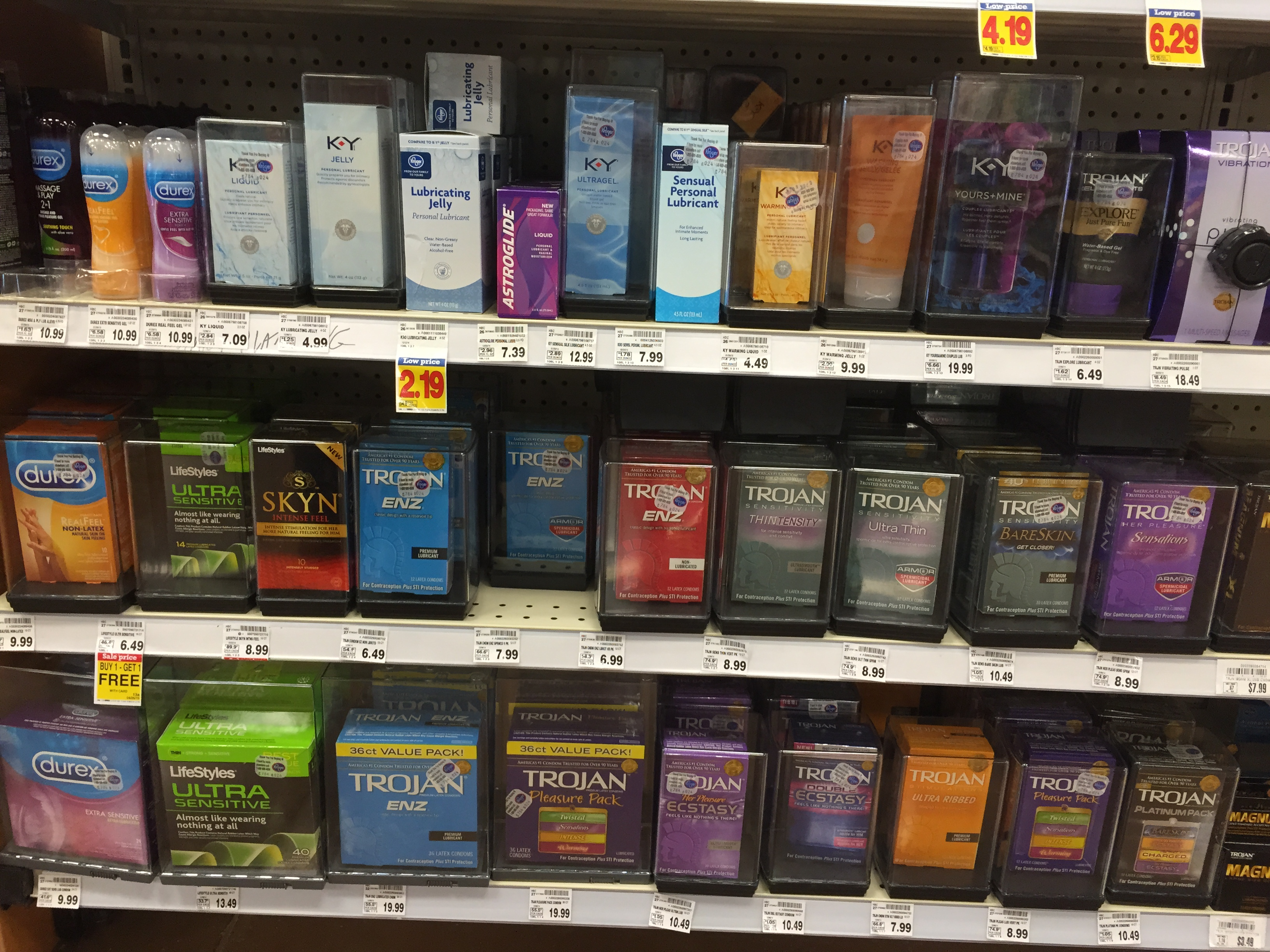
* condoms used to be a necessity for me, but (thankfully) Engineer Hubby and I have eliminated the possibility of more kids. That said, part of the reason, IMO, that we are burning is that there are, simply, too many of us. We suffer from our species’ reproductive success. And *that* said, wouldn’t it make sense for us to support, nay, encourage!, those among us who don’t want kids?

Making it difficult to not contribute to the problem of overpopulation. Again, really?

Making it difficult to avoid contributing to the problem of overpopulation. Again, really?

But at this Kroger’s the condoms are LOCKED UP like they’re ammunition or prescription drugs. Again, really? If I were running the store, I would not only leave these unlocked, I’d place them beside the door. Perhaps with a little sign: “Donations accepted but not required.” Really. Because by the time shoppers get home from hiking through this store, they’re gonna need a foot rub from their partners, and that can lead to, y’know, mashing the potatoes … ah! If only tubers were included on the index.