Tag Archives: writing

Distraction in action

So it’s Happy New Year! And time for a Fresh Start! And Evaluation of the Year Gone By! And Setting of Resolutions! And playing with distractions, like, do I need a coffee grinder that will grind beans fine enough for espresso! Because I cannot figure out the ending of my short story! And I am in despair!

I’ve been worrying that my brain is falling, albeit gradually and gracefully, off the rails, because the ending of this particular story is slippery; I cannot storyboard it, outline it, image-board it. It glimmers in the corner of my eye and then swims away into dark waters, flicking its tail saucily. When this happens, I imagine my brain plummeting, down, down, down, from one of those dramatic high trestle bridges over a roiling river, icy and filled with mysterious silver-green fish.

Embed from Getty Images

Even as part of me feels terror at this fall, another part of me is wondering where such bridges exist, and do the rivers they span have silver-green fish and what would that color be called, anyway, and what would those fish be named and who named them?

And then the timer dings and again I have not gotten anywhere on the story ending. I have generated a list of questions that goes with my other lists of questions and ideas and concepts and free-writes and interesting imagery, stacks of lists tall enough to serve as trestle-bridge supports. Wobbly and unorganized and occasionally coffee-stained supports, but enough to get a steam-engine of a story across the gorge if I could focus on my writing.

Lack of writing focus has been balanced out by my focus on reading in December, however. I spent several hours at the end of 2014 immersed in Gordon Peerman’s book, Blessed Relief: What Christians can learn from Buddhists about Suffering. I don’t identify with either faith, but I relate to suffering.

I’m suffering, I say, as the story-ending vanishes again. I’m suffering, I say, as the timer dings and I have failed, AGAIN, to focus on my writing. I’m not really suffering, I say, as I read the newspaper. I’m suffering with privilege, I say, but it’s not real suffering. I should do some real suffering.

Peerman’s book provided me with a useful perspective on this hilarious-viewed-from-a-distance mindset, particularly with the Five Remembrances practice Thich Nhat Hanh shared in The Blooming of a Lotus. Peerman writes

The intention of this practice is to help you wake up to the significance of this moment, the impermanence of possessions and plans, and the significance of the actions you choose.

The five remembrances themselves are about aging, illness, death, loss, and the results of our actions; for me, they are a mindful articulation about “accepting that which we cannot change,” an adage so overused that it feels watered-down.

Watered-down, downstream, fluid, shape-shifting water, water that roils and dances, water that retains the power to erode granite, to reshape the earth’s contours, to shelter fish, to catch anything that falls from the heavens. Water that runs to the sea. Water that will bear my weight, float me forward.

If I allow myself to float on that water, then my precarious trestle of ideas, my angst-filled train engine of a brain, my inability to catch the glimmering fishtail of my story’s end — all these bits, all I say to myself about how these bits are making me suffer  — they settle, they quiet, they slow. The train puffs to a halt on the bridge and I peer out the window at the river below and crack the window and breathe that crisp river air and the fish jump and sparkle and perhaps my traveling companion knows their name, and then I pick up my pen and return to my notebook, and I am immersed in the writing and when the train moves again its movement is gentle enough to be unnoticeable. Gentle enough, but powerful enough, too. It is enough, what I have. Whether or not I find The Ending to This Story: it is enough. There will be another bridge of ideas over another river, or there won’t. But right here, right now: this is enough. I have enough.

May it be so for your stories, too.
Ice, Water, Steam

The ghost of Christmas (gifts) past

When I was a freshman band geek in high school, a *senior* band geek asked me out. He was a trumpeter, no less, which as every band geek knows, means sexy cut-up, just like percussionist means understated dry wit. I was over the moon.

And then it was Christmas and time to identify and acquire the Perfect Gift. At that time, needlepoint was trendy and most of us girl band geeks traveled with tidy little bags containing three-strand yarn and mesh with various per-square-inch holes. We stabbed that mesh with our dull-tipped needles, colorful trailing yarn pulled taut to make pillows and ornaments and picture frames and belts. Yes, belts. The preppier the better. Argyle patterns were in, and plaid. ‘Nuff said.

The trumpeter made it clear he wanted a belt for Christmas. By mid-December, I was a needlepointing ninny.

Despite my quick flautist fingers, however, when I took the piece to the shop to be finished — I wasn’t skilled enough to affix the leather backing — I was too late for it to be finished by Christmas.

Despair! Gnashing of teeth! Etcetera!

Then my mom suggested I make him a little card explaining the belt would be done by New Year’s, and bake him brownies so he could fatten up in the meantime.

Perfect! Funny! Etcetera!

I made the brownies, I hand-lettered the little card, I wrapped the brownies in wax paper and I packed them in a foil-lined box and I presented it on Christmas Eve.
Embed from Getty Images

Trumpeter opened the box, read the note and said, “oh.”

I explained, in case it wasn’t clear, that the brownies were to fatten him up. Wasn’t that funny?

No. It wasn’t funny.

This was the first death knell of that teen romance. Even then, submerged in teen-girl-preppy-culture, I had a nascent hunch that the tedious stitching of a needlepoint belt for a societally-dictated, consumer-driven celebration of a holy man’s life was not a path I would find spiritually, morally, or ethically satisfying. My hunch has proven accurate.

And I have a sneaking suspicion, based on my life-long, do-it-at-the-last-minute time “management” style, that I could have started on the belt a bit sooner, and had it finished in time for Christmas. I have a sneaking suspicion that all other reasons aside, my boyfriend wanted to know that I’d cared enough about him to make the effort to get my present for him done on time. I have a sneaking suspicion his disappointment was warranted.

The best gifts are the ones that connect us to others, by speaking to the recipient in a language they understand. Like ice cubes:

Embed from Getty ImagesWe have a family friend who loves ice in her drinks, and since we don’t have an automatic ice-maker, several days before she arrives, I start freezing ice cubes. I empty and re-fill the trays several times, so we have a goodly supply. Last time she visited she thanked me, acknowledging that having enough ice for her (many!) drinks requires me to think and act ahead of time, and she felt loved, knowing that I was thinking about taking care of her need in that way. Knowing that we hold enough space in another’s heart and mind to be considered even when we’re absent is powerful.

So this year I’m aiming for gifts that are the equivalent of a full box of ice cubes. Gifts that let others know I notice them, and delight in them, and appreciate them.

This requires consideration, planning ahead, forethought. It’s like writing an essay or a short story or a blog post: first I notice, then I ponder, then I write, then I rewrite, then I share. I’m noticing and thinking about my sons, and my husband, and my friends. I’m making a few things, buying a few things, writing a few things down for “essay” gifts. I’m trying to be timely this year, so my family and friends know that they hold spaces in my heart that I honor and attend to — that they are important enough to come first, not put off ’til the last minute.

May it be so.*

*And if it may not be so, may my brownies provide sufficient occupation until my gifts are completed.

Helloooo, Bagels! Or, I want it all.

When we moved from Boston to Blacksburg, 20+ years ago, I had a “quality of life” checklist. It included access to the New York Times and a particular brand of chocolate. Both were available at that time; tellingly, a daily NYT is no longer available (tho’ Sundays edition is) but the sheer variety of chocolate available now has increased by a factor of ten. You can get organic, you can get fair trade, you can get single-source, you can get flavors: cocoa nibs, burnt caramel, candied bacon. Quality of life indeed!

Hello Bagel is on South Main Street, a few doors down from the Vintage Cellar.

Hello Bagel is on South Main Street, a few doors down from the Vintage Cellar.

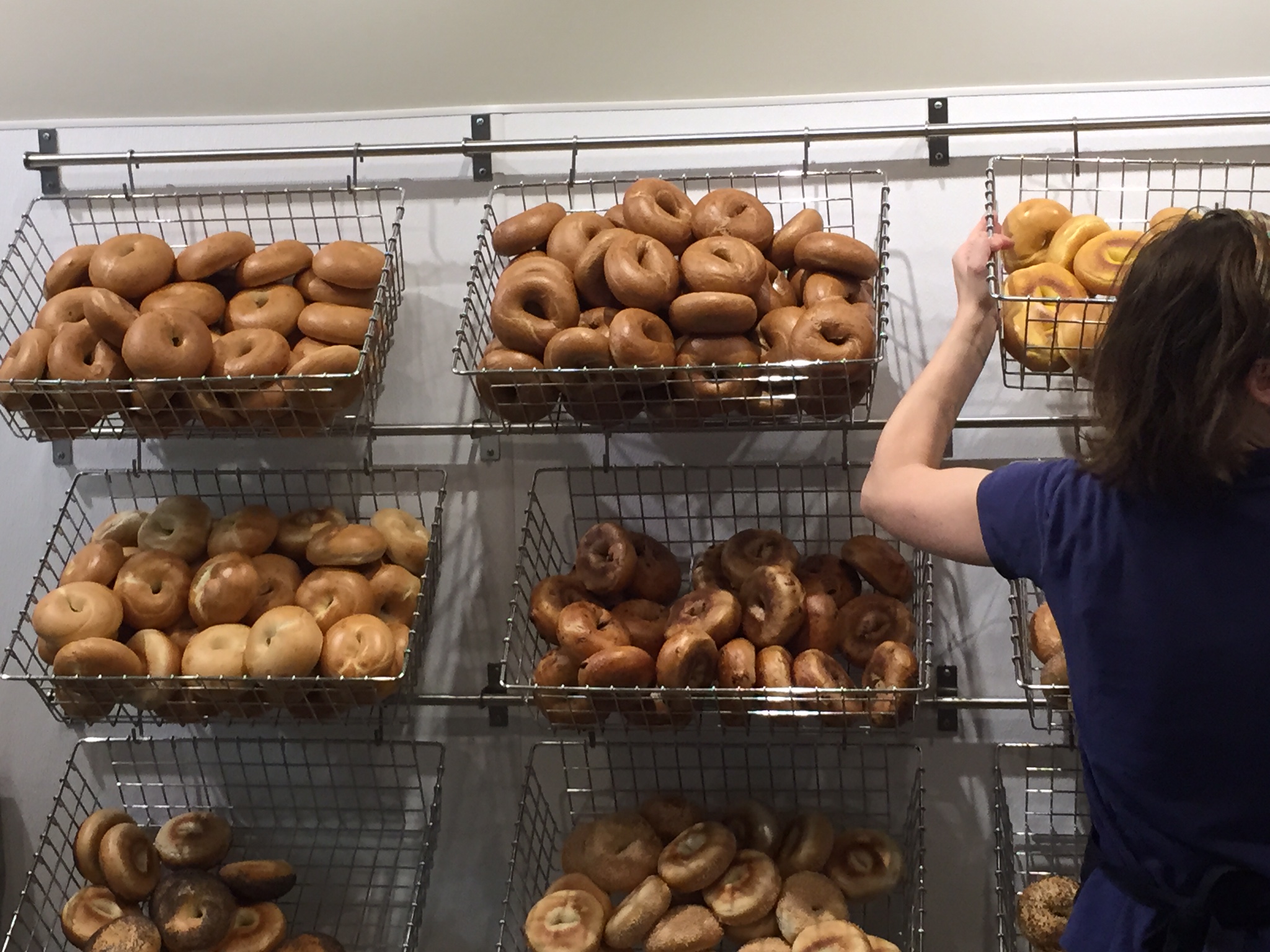
However, until this past Monday, there was no decent bagel shop in Blacksburg. There was a spot about ten years ago that folded. There are frozen options. There’s a supplier that comes to the farmer’s market and the local food coops.

So when I heard about the “soft” opening of Hello Bagel, I set my alarm for 6:15 and I stumbled to the car in the dark and I drove ‘cross town and I paid for still-warm bagels and a cup of coffee and lo, it was almost a religious experience. It certainly restored my faith in the virtue of rising early.

And here’s the rub, for me: the only reason Blacksburg now boasts a bagel shop is that this small town ain’t so small anymore. (When we arrived in ’92, I could get anywhere in town in 10 minutes, tops. Today, I plan on twenty, or thirty if I want to be able to walk into my meeting instead of run (yes, big-city dwellers, I realize that’s not a “real” commute). I miss the small town I moved to.

BUT: if there weren’t so many people here, the writing workshops I’m offering (another shameless plug: The Joyful Quill) wouldn’t have enough participants to come alive. The writers’ groups I work with would have no new faces.

And those those who live in Real Cities will point out: uh, you do live in a small town. They’re right, of course. And so am I. Blacksburg is small. It used to be smaller. And it’s smaller than it (probably) will be in ten years.

Holding both these perceptions without denying the accuracy of either one acknowledging that more than one thing may be “true” is uncomfortable: we want Our Way to be the Right Way. If Other Ways are equally valid, then what does that make me? Wrong? I don’t want to be wrong!

A colleague recently shared an observation of me as “too worried with what other people may think.” I can’t argue. More often than not, in any given group of people, I am more interested than others in considering the possible ways my actions, or the actions of my group, may be perceived.

And don’t the Great Writers ignore what others think? Wield a machete through the thicket of conventional writing? What if Virginia Woolf had done nothing but worried about what people thought of her work? No Mrs. Dalloway? Perish the thought!

But I’m not aiming for Great Writer status. I’m aiming for sustaining my self through my writing. I’m aiming for connecting through well-crafted stories. I’m aiming for providing a writing space where people leave feeling *more* like writing than when they arrived. I’m aiming for accepting people where they are as writers, not labeling some “good” and the rest “bad.” *

I want it all: a town where I can get a terrific bagel and arrive ten minutes later at my writing group, with said bagel still warm, its schmear of cream cheese a little melty.

Bagel flavors galore!

Bagel flavors galore!

I’m not gonna get it all. I am gonna enjoy sitting in the middle of it all, noticing the contradictions inherent in my big small town, in writing with and against conventions, in considering what others may think, and deciding if and when to cast it aside.

There’s a lotta bagel flavors out there. I’m gonna try them all.

*I can hear the critics thrashing and gnashing: but some writing IS better than others! There are so “right” and “wrong” ways to write! And I agree: for publication, you betcha there are standards. I also note that standards deemed James Joyce’s Ulysses obscene. Standards pilloried Kate Chopin for The Awakening. We want it both ways but that’s a tough row to hoe: be a Great Writer that ignores standards AND adhere to the conventionally-accepted “right” and “wrong” ways of writing or your work won’t see the light of day, and your career will be kaput. I’m all about figuring out what we want to say and saying it to the best of our ability but hey: eyes wide open, folks. Every rant is not genius, today’s anointed geniuses may be tomorrow’s remainders, and every unpublished, half-way decent writer who keeps getting up early, making coffee, and setting their thoughts down, on anonymous paper in an anonymous house in an anonymous life — they are countless. I don’t know how to fit them into this paragraph. But I honor their attention to their writerly selves.