Aside

My friend and writer colleague Val Brooks has honored me with an Award. Check  it out here — the post also has thoughtful reflections on the whole awards culture. Then browse through her piratese-based blog, Gobsmacked, about writing!

Paying attention and honoring what we see …

My eldest son plays hard, Image by Jeannine Eddleton

I’m writing this as my older son sleeps, hopefully deeply enough to restore his depleted energy after yesterday’s intense soccer matches.  What a range of soccer parents schlep their kids to these games! There are of course the win-at-all-costs parents – and it’s not only dads who scream at players – but that is a stereotype, just as “the people” that are referred to during election seasons don’t fit into the stereotype of the shorthand labels we bandy about like Truth. When it comes down to it, most Tea Partiers, moderate Republicans and Blue Dog Democrats, in checkout lines and over a cup of coffee, would manage to find commonalities. Everyone has red blood.

And we all support our kids. No matter how we support them in their passions, most of us make an effort because we love our children and want to honor the spark of life manifest in their desires. Best as we can, we notice, nurture, and navigate the world to facilitate setting their ever-growing-and-when-they’re-teenage-soccer-players-STINKY feet on paths that in our (necessarily limited) experience will help them discover whether or not their passion is vocation, avocation or occasional hobby.

typewriter.detail5

ye Olde Typewriter, Image by jcbonbon via Flickr

My parents were among the first to show me the path I’m on now. They read to me, gave me books from their childhood – and when I happily scrawled my own stories in kindergarten, they hied me to the library weekly, pointed out books about writers, outfitted an old desk with an equally old (manual!) typewriter and all the scrap paper I wanted. I wasn’t sent to any special camps, but they certainly honored what they witnessed in me.

Nonetheless: when I see a van full of kids being chauffeured down the interstate to soccer tournaments, or youth orchestra, or juggling classes, an echo of an interview rings in my head.

A female author was sharing her story of achieving success in her forties after a twenty-year hiatus (cannot for the life of me remember who it was, my apologies). She’d achieved a modicum of publishing success immediately after college, then fell in love and had a child. And a second. Not surprisingly, her creative output trickled and ceased. She’d found a mentor before she’d begun childrearing, and when she and her partner were debating adding a third child to their family, the mentor opined: every child you have is another novel you will not write.

I heard this while driving to work, pregnant with the boy who is now snoring quietly in the adjacent room (yes, I am drafting this in the hotel room’s bathroom, so the lights don’t wake him up, my forty-something butt cushioned by hotel towels).

The mentor was correct. I certainly have three or four collections of ideas and plot outlines and free writes that, given time enough, could well be novels, but probably won’t be. Because I am raising children as well as writing.

Portrait of Virginia Woolf

Virginia Woolf: proof positive that great art is unrelated to one's parental status.

The mentor was also incorrect.  Despite the real and metaphorical headaches of bringing up my boys, and the incredible amount of time they consume, I could not possibly write as I do if I were not a parent. I imagine my writing would be different (not better or worse, different) if Engineer Hubby and I had remained child-free. This is certainly NOT to say those who aren’t parents don’t create complex, rich, and marvelous art. Arguably, since historically men have comprised the majority of the artist class and, also historically, they were very minimally involved in the grind of parenting, it’s hardly a requirement for great art. Or lousy art.

However, bottom line, one needs extended periods of solitude to make *anything* (nine months gestations for humans plus 18 years for ripening … no wonder Donna Tartt takes a decade per novel!), so hands-on parenting necessarily compromises those of us with artistic bents.  “Oh, but it’s worth it,” we say, after griping about our finicky eaters or the history teacher who doesn’t understand our precious progeny.

Actually, it’s not worth it, financially, for many of us. Nor is it even metaphorically worth it on the days consumed by the thrust-and-parry around their so-called “needs.” (I NEED an Xbox. Uh, no, you don’t. You need to get your ass outside and run a couple miles so you’re too tired to whine about material goods. Then you need to take out the compost so your mother doesn’t use words no former English major should unleash on her children before they’re twenty-one.)
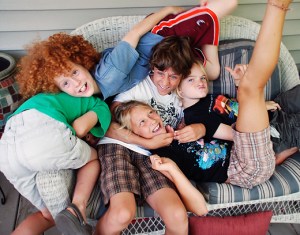
Kids! Image by the awesome Anne Jacobsen

But our lives, with all the warts, whining, and wasted moments, are what we have to work with. The consequences of our choices, be they nights of passion or carefully plotted and sought-after goals, are with us. Here. Now. Though they won’t always be (we have fewer years with our kids at home before us than we have behind us).

These moments, on these days, the choices I make to write or not write, even if only for five minutes, is all that is. Annie Dillard is credited with the succinct, truthful observation that “How we spend our days is, of course, how we spend our lives.”

She’s right. If I want to write, even if it’s only for my eyes only, even if I aim for publication and fail, then I have to do it. Writers write. Period.

My parents noticed and honored the writer they saw in their little girl. Surely, even as I pass the gift of honor on to my sons, and chauffeur them hither and yon, I can continue to honor my own girl. Reading stories and making up my own, scrap paper at the ready.

Walking in the Woods: Playing with Metaphor

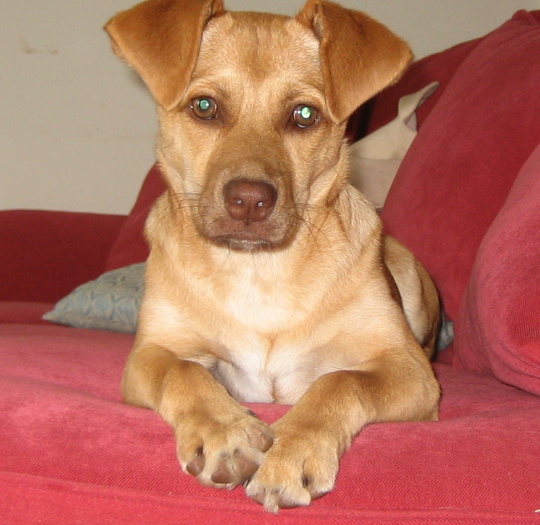
The dawg I luuuuv

As most of you already know, I am in love with my dog Penny in the way only someone who was “dog-deprived” as a child (my dad was allergic) can be: I love her eyes, her floppy ears, her stump of a tail, the color of her fur (a new copper penny, hence her name), her wiggly ecstasy upon my return home – everything.

I also love taking her for walks, and walking her is one of the few things I make time for every day, rain, shine, wind, sleet, snow, sun, humidity, cold, drizzle (yes, she wears a coat because otherwise, short-haired mutt that she is, she shivers).  I don’t feel it’s fair to only allow a dog outside to “do its business” (a hilarious euphemism, though perhaps much of “business” in the economic sense is peeing and pooping as well).  So. I walk the dog.

Because I enjoy seeing places change with time,  I repeat a few dog walk loops: woods to bike path; longer walk than usual along the main road (sometimes with a stop for a tasty beverage at the coffeeshop); to the old apple tree at the once-was-a-farm park adjacent to our woods.

Big trees of the woods; photo by Anne Jacobsen

The woods are my favorite. Its trees are probably 60-80 years old and provide a backdrop for our cluster of houses. The topmost branches sway dramatically in the winds that bring the cold fronts. I am chronically astonished they remain connected to the earth in the big gusts, and still need to reassure both my sons that their roots are very very deep. “No, the trees are not likely to fall on our homes,” I say. Hoping I’m right.

I unleash Penny in the woods and she dashes after squirrel! Deer! Chipmunk! Fox?! And I mosey along behind her (or trot, if I’m running late).

Mushroom in the woods

The woods are full of surprises. There’s a hollow tree stump containing a wad of tin foil and three golf balls. The work of a crow, I believe. There’s a very small area where rocket flowers grow, on the slope to the creek. I haven’t seen it anywhere else. Mayapples run riot in the spring; mushrooms of all types and sizes — from enormous puffballs to tiny, brilliant orange ones —  multiply in late summer and early fall. Moss expands and contracts along tree trunks depending on humidity and temperature.

The trail we humans have etched runs up and down the slopes, with gentle switchbacks; the deer’s tracks, obvious in winter, run perpendicular to ours.

Every year I am certain that this spring’s first tender green and this fall’s sharp crimsons have never, NEVER, been so lovely. I know I’m forgetting last year’s palettes, but I don’t mind. I’m fine with letting today be the prettiest day ever rather than lamenting that it doesn’t compare with those gone by.

But this year is the first time I can remember being caught unawares by the trail’s disappearance under the drifts of leaves.  [Warning:  obvious metaphor for writing practice is beaten to death in the remainder of the post.]

Fall arrived in fits and starts this September, an early cold drizzly couple of days followed by warm temperatures and sun enough to ripen my last few tomatoes and encourage the foxgloves to produce a last cluster of blooms. The leaves turned all the stereotypical colors and shone against the fall sky’s blue dome. In mid-October the trail remained visible despite some accumulation of the trees’ cast-offs. My footfalls, and those of my fellow hikers, kept it relatively clear.

Then a cold front screamed in and tore the leaves off the branches: the next day the trail had vanished. Did I usually walk between those two trees or skirt them? And what are those trees? Without their leafy cloaks, I can’t hazard a guess. The rocks that bump up from the earth, the tree roots that lace across the path: all invisible, hidden. I stumbled once, twice, thrice and though I managed to keep my balance, these thoughts sluiced through my mind:

  1. I don’t know these woods as well as I think I do.
  2. Thank goodness I’m not of an age to worry about breaking a hip if I fall. Yet. This led to:
  3. Will I ever be too old to walk in the woods?
  4. Will I walk in the woods regularly when Penny dies?
  5. I don’t want Penny to die!
  6. I don’t want to die. Yet.
  7. This is a metaphor for my writing life …

I played with the hidden trail as metaphor …

  1. I don’t know my writing as well as I think I do (one of my latest drafts “birthed” a skinny, opinionated rural Virginia girl-woman whose sister is sneaking out at night to bury roadkill: I’ve been thinking about someone who buries roadkill for years, but not her sister, who is dominating the story!).  My writing path is obscured just as quickly when a metaphorical storm blows through and I have to tend to my family rather than my writing (the flu, allergy shots, doctor appointments, etcetera: all those “leaves” flew down at once and I was away from my writing for a week and when I sat down again I was utterly … lost).
  2. I’m still young enough to write although I find reading glasses enormously helpful … this leads to:
  3. Will I ever have hands too arthritic, reflexes too slowed, eyes too cataracty to NOT write?
  4. Will I continue to write when I don’t have to squeeze it in between family duties? Sometimes not having much time really lights a fire under me.
  5. I don’t want to not have the desire to write
  6. I don’t want to die. Yet.
  7. Perhaps my writing practice is a metaphor for my life …

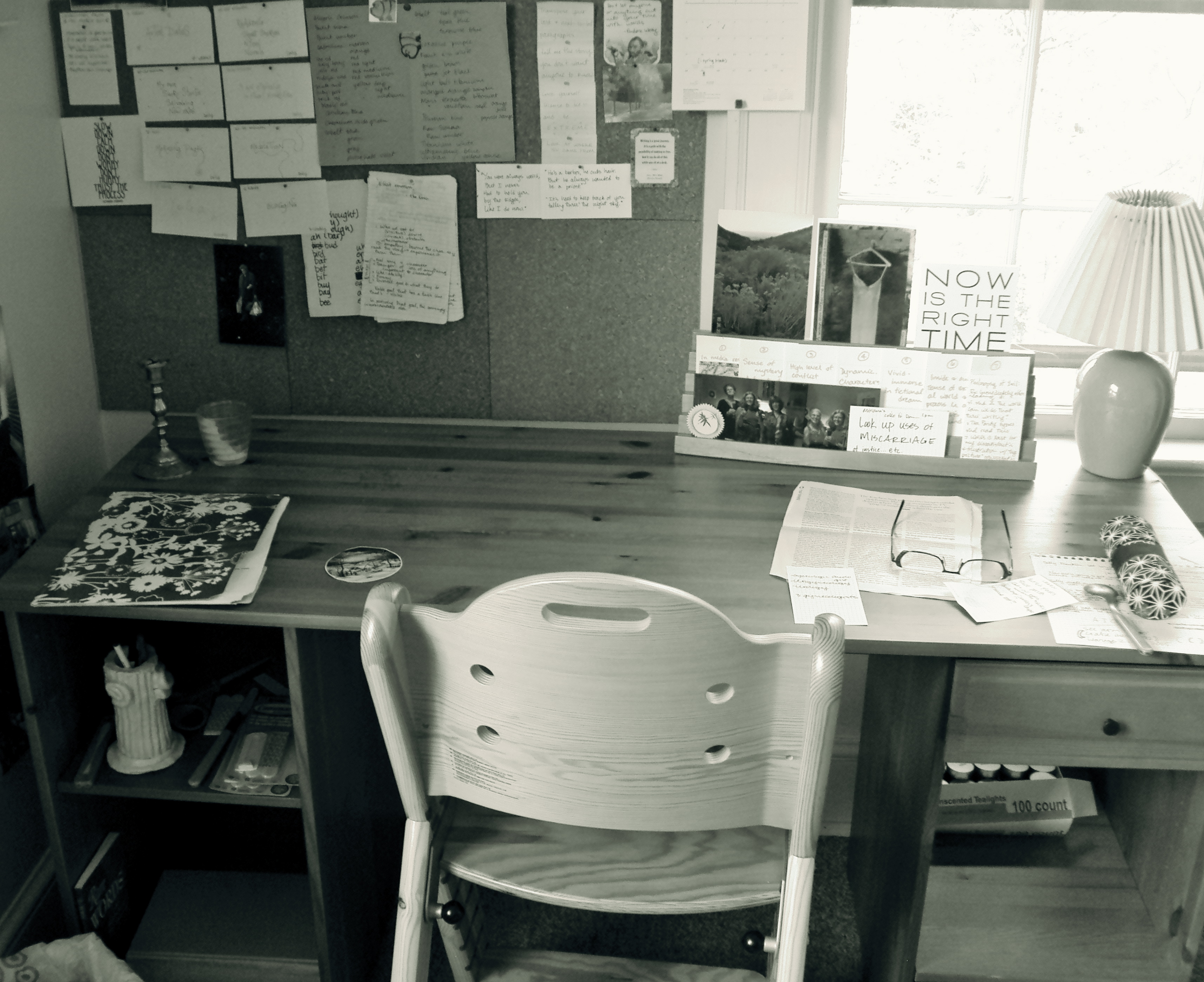
Writing desk 2011

The days are good when I can see my way clear – with or without stumbling – to time at my writing desk. I trust – I have to trust! – that if diminishing eyesight and worn-out ligaments impact my ability to “walk” my writing path, I will figure something out by putting one proverbial foot in front of the other, perhaps stumbling, but more often than not catching my balance. I trust that aging’s inevitable questions of “what now?” will arrive with winds strong enough to transform the trail in ways I can’t yet know, and that when those days arrive they, too, will be the most gorgeous days I have ever seen. In a different way. Perhaps while wearing Depends. But still gorgeous.